How Does the Election Commission of India Conduct the World's Largest Election?
By: Search Sarkari Naukri Team · Published: · Updated: · 4 min read
Quick summary
India conducts the world's largest democratic election involving hundreds of millions of voters. Discover how the Election Commission of India manages this massive exercise with technology, planning, and thousands of officials.
- Primary topic
- Election Commission of India
- Category
- Government System
- Reading time
- 4 minutes
- Last reviewed
- 2026-08-20
How Does the Election Commission of India Conduct the World's Largest Election?
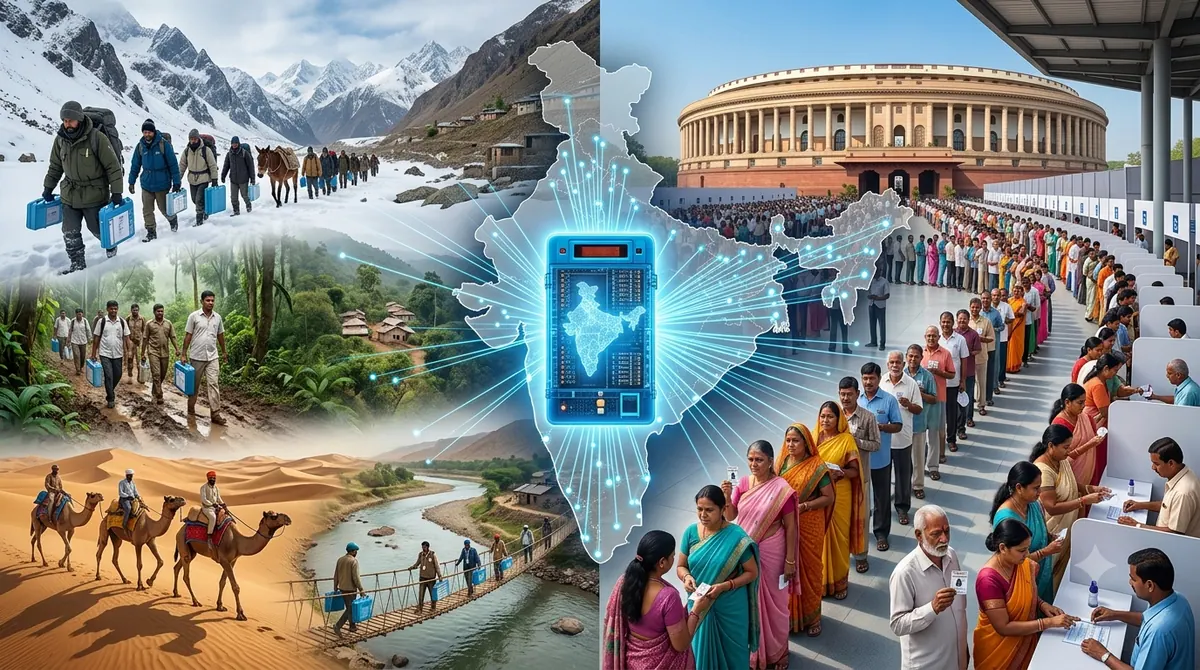
India is often called the world's largest democracy, and for good reason. During every Lok Sabha election, hundreds of millions of eligible citizens cast their votes across thousands of cities, towns, villages, mountains, forests, deserts, and even remote islands.
Organizing an election on such a massive scale is a remarkable administrative achievement. Behind every polling booth, Electronic Voting Machine (EVM), voter list, and election result is months of careful planning carried out by one constitutional authority—the Election Commission of India (ECI).
But how does the Election Commission successfully conduct one of the largest democratic exercises on Earth?
Let's understand the process in simple language.
What Is the Election Commission of India?
The Election Commission of India (ECI) is an independent constitutional body responsible for conducting free and fair elections in the country.
It supervises elections for:
- Lok Sabha
- Rajya Sabha
- State Legislative Assemblies
- The offices of the President and Vice-President of India
Its primary responsibility is to ensure that elections are conducted fairly, transparently, and according to the Constitution and election laws.
Why Is Conducting Elections in India So Challenging?
India's elections are unique because of the country's size and diversity.
The Election Commission must manage elections involving:
- Hundreds of millions of registered voters
- Thousands of candidates
- Political parties across the country
- Polling stations in remote locations
- Multiple languages and cultures
- Difficult geographical conditions
Polling booths are established everywhere—from Himalayan villages and dense forests to coastal islands and desert regions—to ensure that every eligible citizen has an opportunity to vote.
Preparing the Electoral Roll
Before elections begin, the Election Commission prepares and updates the electoral roll, commonly known as the voter list.
Eligible citizens who have attained the required voting age can register themselves.
The voter list is regularly updated to:
- Add new voters
- Remove duplicate entries
- Update addresses
- Correct personal details
An accurate electoral roll is essential because only registered voters are permitted to vote.
Announcing the Election Schedule
When the Election Commission announces the election schedule, it specifies:
- Nomination dates
- Scrutiny of nominations
- Last date for withdrawal
- Polling dates
- Vote counting date
- Result declaration
India often conducts elections in multiple phases to ensure that security forces and election officials can be deployed effectively across different regions.
The Model Code of Conduct
As soon as the election schedule is announced, the Model Code of Conduct (MCC) comes into effect.
The MCC is a set of guidelines that political parties and candidates are expected to follow during the election period.
Its purpose is to ensure that elections remain fair and that government resources are not misused for campaigning.
The Election Commission monitors compliance throughout the campaign period.
Polling Booth Preparation
Setting up polling stations is one of the biggest logistical tasks.
The Commission ensures that polling booths are accessible to voters, including senior citizens and persons with disabilities.
Polling teams transport election materials, EVMs, VVPAT machines, and other equipment to every polling station, sometimes traveling through mountains, rivers, forests, or remote villages.
In some cases, election officials travel for days to reach isolated locations.
Electronic Voting Machines (EVMs)
India uses Electronic Voting Machines (EVMs) for recording votes.
Compared to traditional paper ballots, EVMs help:
Speed up voting. Reduce invalid votes. Improve efficiency in counting. Simplify election management.
Before polling begins, EVMs undergo multiple levels of checking and preparation according to established procedures.
What Is VVPAT?
Along with EVMs, many elections also use the Voter Verifiable Paper Audit Trail (VVPAT) system.
When a voter presses a button on the EVM, the VVPAT briefly displays a paper slip showing the selected candidate before securely storing the record.
This provides an additional verification mechanism while maintaining the secrecy of the vote.
Security During Elections
Security is one of the Election Commission's highest priorities.
Central and State security forces are deployed to:
- Protect polling stations
- Maintain law and order
- Safeguard EVMs
- Ensure peaceful voting
- Prevent unlawful activities
Special arrangements are made for sensitive polling locations wherever necessary.
Counting the Votes
After polling concludes, EVMs are securely stored until the scheduled counting day.
On counting day, officials follow established procedures while representatives of candidates observe the process.
Votes recorded in the EVMs are counted, and the results are compiled constituency-wise.
Once counting is completed, the Election Commission officially declares the winners.
How Does Technology Help?
Technology has made elections more efficient.
Today, the Election Commission uses digital systems for:
- Online voter registration
- Electoral roll management
- Candidate information
- Polling logistics
- Election monitoring
- Public awareness campaigns
These technological improvements help streamline one of the largest administrative exercises in the world.
Why Is the Election Commission Independent?
The Election Commission functions independently so that elections remain impartial.
An independent election authority helps build public confidence in the electoral process by ensuring that every political party and candidate competes under the same rules.
This independence is considered one of the foundations of India's democratic system.
Why Is India's Election System Admired Worldwide?
Many countries study India's election management because of its remarkable scale and complexity.
Successfully conducting elections across a country with immense geographical diversity, multiple languages, and one of the world's largest electorates demonstrates exceptional administrative planning and coordination.
The Election Commission's ability to reach even the most remote polling stations reflects India's commitment to ensuring that every eligible citizen has the opportunity to vote.
Frequently asked questions
How Does the Election Commission of India Conduct the World's Largest Election?
India is often called the world's largest democracy, and for good reason. During every Lok Sabha election, hundreds of millions of eligible citizens cast their votes across thousands of cities, towns, villages, mountains, forests, deserts, and even remote islands. Organizing an election on such a massive scale is a remarkable administrative achievement. Behind every polling booth, Electronic Voting Machine (EVM), vot
But how does the Election Commission successfully conduct one of the largest democratic exercises on Earth?
Let's understand the process in simple language.
What Is the Election Commission of India?
The Election Commission of India (ECI) is an independent constitutional body responsible for conducting free and fair elections in the country. It supervises elections for: Lok SabhaRajya SabhaState Legislative AssembliesThe offices of the President and Vice-President of India Its primary responsibility is to ensure that elections are conducted fairly, transparently, and according to the Constitution and election law
Why Is Conducting Elections in India So Challenging?
India's elections are unique because of the country's size and diversity. The Election Commission must manage elections involving: Hundreds of millions of registered votersThousands of candidatesPolitical parties across the countryPolling stations in remote locationsMultiple languages and culturesDifficult geographical conditions Polling booths are established everywhere—from Himalayan villages and dense forests to c
What Is VVPAT?
Along with EVMs, many elections also use the Voter Verifiable Paper Audit Trail (VVPAT) system. When a voter presses a button on the EVM, the VVPAT briefly displays a paper slip showing the selected candidate before securely storing the record. This provides an additional verification mechanism while maintaining the secrecy of the vote.
How Does Technology Help?
Technology has made elections more efficient. Today, the Election Commission uses digital systems for: Online voter registrationElectoral roll managementCandidate informationPolling logisticsElection monitoringPublic awareness campaigns These technological improvements help streamline one of the largest administrative exercises in the world.
Why Is the Election Commission Independent?
The Election Commission functions independently so that elections remain impartial. An independent election authority helps build public confidence in the electoral process by ensuring that every political party and candidate competes under the same rules. This independence is considered one of the foundations of India's democratic system.
Why Is India's Election System Admired Worldwide?
Many countries study India's election management because of its remarkable scale and complexity. Successfully conducting elections across a country with immense geographical diversity, multiple languages, and one of the world's largest electorates demonstrates exceptional administrative planning and coordination. The Election Commission's ability to reach even the most remote polling stations reflects India's commitm
Continue your preparation
Topics covered
About the author
Search Sarkari Naukri Team reviews government-job information, competitive-exam guidance and public-system explainers. Verify time-sensitive requirements on the relevant official authority's website.
Related articles
- Can a Government Employee Be Transferred Against Their Will? The Rules Explained — Government System
- What Happens When Your Dream Exam Is Not Your Best Opportunity? — Exam Culture & Society
- Is a Government Job Still the Best “Safe” Career Choice? — Careers & Society
- What Is a Gazetted Officer? And Why Their Signature Matters — Government Policies & Explained
- Why Do Aspirants Feel Guilty for Having a Backup Plan? — Exam Culture & Society
- Title: Why Does Preparing for a Government Job Sometimes Feel Like a Full-Time Job? — Exam Culture & Society