Government Jobs That No Longer Exist: Careers Lost to Time
By: Search Sarkari Naukri Team · Published: · Updated: · 4 min read
Quick summary
Not every government job has survived the march of time. Some once played a vital role in India's administration but disappeared as technology, modernization, and changing laws transformed the way the government works.
- Primary topic
- Government Jobs
- Category
- Interesting Facts
- Reading time
- 4 minutes
- Last reviewed
- 2026-08-20
When people think about government jobs, they usually imagine careers that last forever.
After all, one of the biggest attractions of a government job is stability. Departments may change, technology may evolve, and governments may come and go—but the jobs themselves seem permanent.
Or are they?
Believe it or not, India has had several government jobs that completely disappeared over time. Some existed for decades. Others were once considered essential to the functioning of the country. Today, many young aspirants have never even heard their names.
The reason isn't that these jobs failed.
It's that the world changed.
Take the Telegraph Operator, for example.
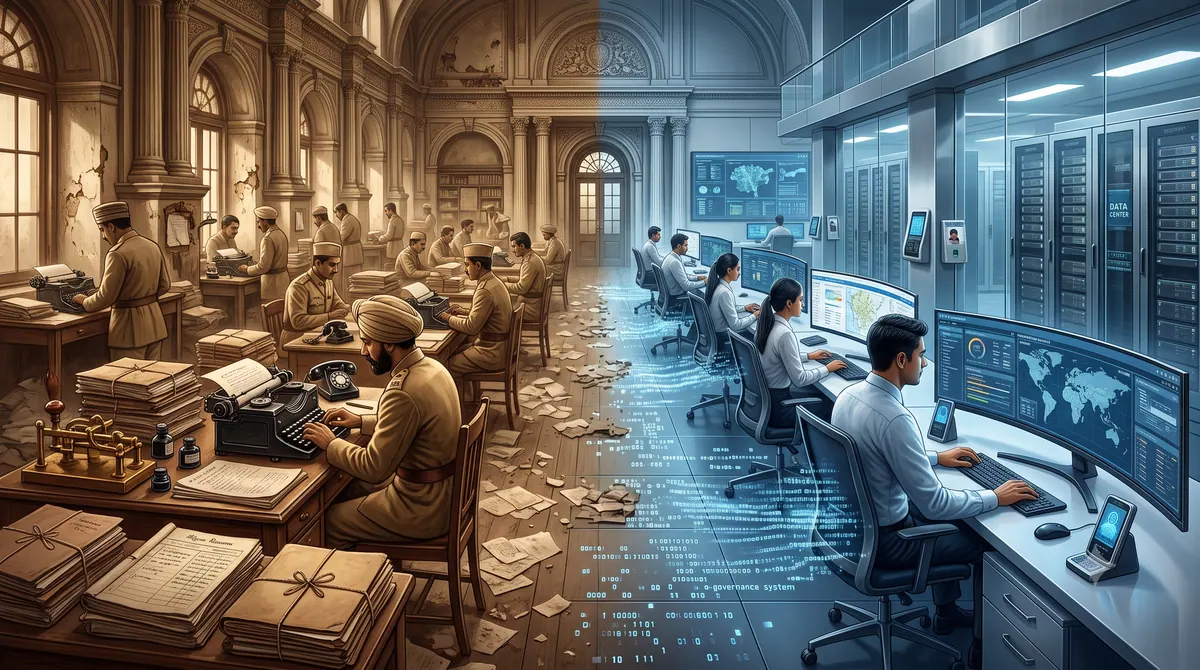
Long before mobile phones, emails, and instant messaging, telegrams were the fastest way to deliver urgent information across the country. Births, deaths, exam results, government orders, and emergency messages all travelled through telegraph offices. Skilled operators converted messages into Morse code and transmitted them across vast distances.
It was one of the most respected government careers of its time.
Then came the internet.
Mobile phones became common. Email replaced telegrams. Messaging apps made communication almost instant. As technology advanced, telegraph services gradually became unnecessary, and the role eventually disappeared.
Another interesting example is the Typewriting Pool.
There was a time when every government office depended on trained typists working on heavy mechanical typewriters. Every official letter, report, circular, and government order had to be typed manually. Accuracy was everything because correcting mistakes often meant typing the entire page again.
Today, computers have replaced almost every mechanical typewriter. While typing skills remain important, the dedicated government typewriting pools that once employed thousands of people have largely become a part of history.
Government record-keeping has also undergone a massive transformation.
Years ago, offices maintained enormous paper registers that tracked everything from land ownership to employee records. Entire teams were responsible for manually updating these registers, preserving files, and maintaining archives.
Now, digital databases perform much of the same work in seconds. Many government departments have adopted e-governance systems that reduce paperwork, improve efficiency, and make information easier to access.
Even communication inside government offices has changed dramatically.
Before digital networks became common, departments relied heavily on messengers carrying files and official correspondence between offices. Physical movement of documents was a daily responsibility requiring dedicated staff.
Today, many approvals happen electronically, significantly reducing the need for manual file movement.
This doesn't mean technology has reduced government employment.
In fact, it has created entirely new opportunities.
As traditional roles disappeared, new careers emerged in information technology, cybersecurity, digital governance, data management, artificial intelligence, online public services, and digital infrastructure. Government departments today need professionals who can manage secure digital systems just as much as they once needed telegraph operators and typewriters.
That's one of the fascinating things about public service.
The mission stays the same.
The methods keep evolving.
Many aspirants worry that technology will eliminate government jobs completely. History suggests something different. While certain roles become obsolete, governments continue adapting to society's changing needs by creating new positions that didn't exist a decade earlier.
Think about it.
Twenty-five years ago, few people imagined departments hiring experts to manage digital identity systems, online citizen services, or cybersecurity. Today, these responsibilities are becoming increasingly important across government organizations.
Every generation sees this cycle.
Old jobs disappear.
New jobs are created.
The skills required simply evolve with time.
For government job aspirants, this is an important lesson. Instead of preparing only for today's vacancies, focus on building adaptable skills. Digital literacy, communication, analytical thinking, and problem-solving are becoming valuable across almost every department.
The government of the future won't look exactly like the government of the past.
And that's a good thing.
Progress doesn't erase public service—it reshapes it.
The next time someone says government jobs never change, you'll know the truth. They do change. Some careers become history, while others emerge to solve the challenges of a new generation.
Understanding that evolution isn't just interesting—it's a reminder that the future of government employment will always belong to those willing to learn and adapt.
Continue your preparation
Topics covered
About the author
Search Sarkari Naukri Team reviews government-job information, competitive-exam guidance and public-system explainers. Verify time-sensitive requirements on the relevant official authority's website.
Related articles
- What Happens When Your Dream Exam Is Not Your Best Opportunity? — Exam Culture & Society
- Is a Government Job Still the Best “Safe” Career Choice? — Careers & Society
- What Is a Gazetted Officer? And Why Their Signature Matters — Government Policies & Explained
- Why Do Aspirants Feel Guilty for Having a Backup Plan? — Exam Culture & Society
- Title: Why Does Preparing for a Government Job Sometimes Feel Like a Full-Time Job? — Exam Culture & Society
- What Does “Job Security” Actually Mean Anymore? — Work & Society