Why Are So Many Educated Young Indians Competing for the Same Few Jobs?
By: Search Sarkari Naukri Team · Published: · Updated: · 7 min read
Quick summary
India has more graduates than ever, yet competition for stable and desirable jobs remains brutal. Why are so many educated young people chasing the same limited opportunities—and what does that reveal about India's job market?
- Primary topic
- Indian youth
- Category
- Education & Society
- Reading time
- 7 minutes
- Last reviewed
- 2026-09-08
More Degrees. More Applicants. Still Not Enough Good Jobs.
India is producing more educated young people.
College enrolment has expanded. More students are earning degrees. More young people are entering the labour market with qualifications their parents may never have had.
That should be good news.
But there is a weird contradiction.
For many desirable jobs, competition is becoming absolutely brutal.
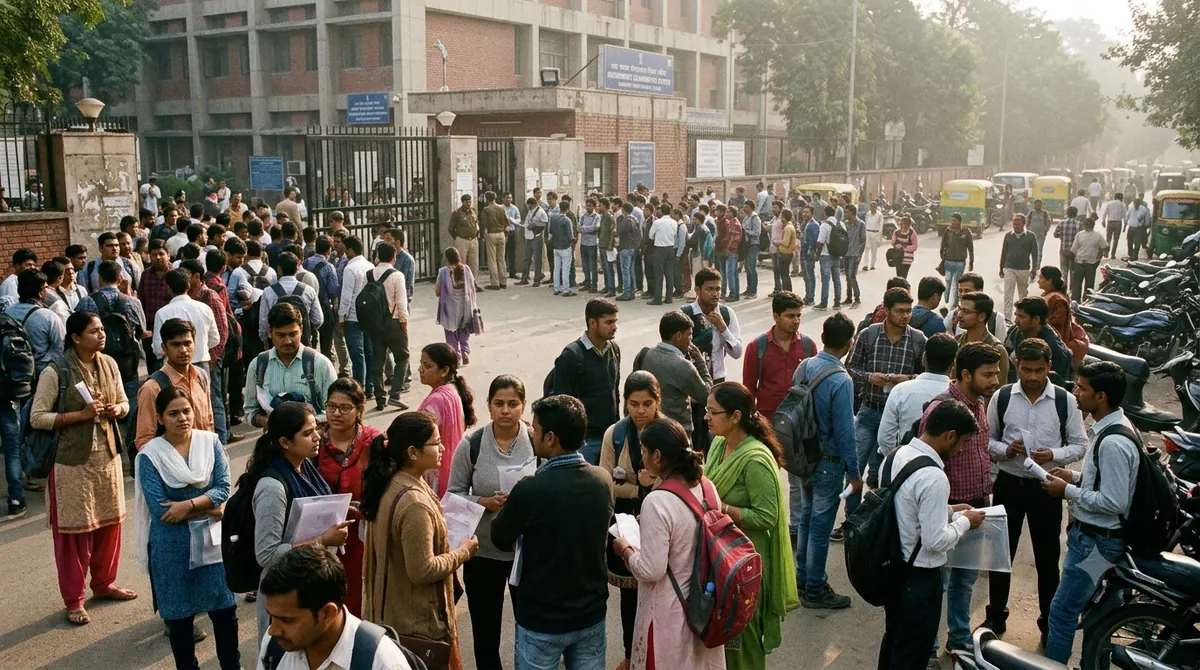
Lakhs of candidates apply.
Vacancies are counted in hundreds or thousands.
A recent World Bank framework notes that around 12 million young people enter India's labour market every year, making large-scale job creation a central challenge.
So why are so many educated young Indians competing for the same few jobs?
The answer is more complicated than simply saying:
“There are no jobs.”
The real issue is often the gap between having a job and having a job that offers enough stability, income, security and future prospects to feel worth pursuing.
A Degree Is More Common. A Good Opportunity Is Not Guaranteed.
For decades, education was sold with a fairly simple promise:
Study hard → get a degree → get a better job.
That promise has become less automatic.
A degree still matters. It can open doors, provide eligibility and improve opportunities.
But as more people earn degrees, the degree alone becomes less able to separate one candidate from another.
This is sometimes described as credential inflation.
If 100 people have a qualification, the employer or recruiter still needs a way to select a smaller number.
Then other filters appear:
- Competitive exams
- Entrance tests
- Experience
- Skills
- Interviews
- Certifications
- College reputation
- Aptitude tests
So the degree gets you into the competition.
It does not guarantee that you win it.
NITI Aayog's 2026 working paper on education and skilling specifically examines the shift from focusing only on credentials toward greater attention to actual learning outcomes and employment relevance.
That distinction matters.
More qualifications do not automatically mean more suitable opportunities.
Why Government Jobs Attract Such Massive Competition
Let's be honest: government jobs are not popular just because people like solving reasoning questions.
They are attractive because many candidates associate them with things that are difficult to find elsewhere:
- Job security
- Predictable career structures
- Regular income
- Benefits
- Social status
- Long-term stability
Research on India has found that government jobs can carry substantial value, and highly structured competitive exams receive thousands of applications for individual vacancies.
Recent analysis from JustJobs Network argues that fierce competition for government jobs reflects more than a simple preference for the public sector. It also reflects a shortage of enough secure, productive and dignified opportunities matching the aspirations of educated young people.
That's the key.
A person may technically have other employment options.
But if those options are:
- Low-paying
- Unstable
- Informal
- Poorly matched to their education
- Offering limited growth
they may continue preparing for a more secure position.
So the competition isn't always about finding any job.
It's often about finding a job people believe can support a stable life.
The “Any Job Is Better Than No Job” Argument Is Too Simple
People sometimes look at a graduate preparing for a competitive exam and say:
“Why don't they just take any private job?”
Sounds logical.
But “private job” is not one single thing.
The private sector includes:
- High-paying professional roles
- Stable corporate careers
- Small businesses
- Contract work
- Sales jobs
- Informal employment
- Low-paid entry-level work
Lumping all of them together as simply “jobs” hides a massive difference in quality.
For many young people, the decision isn't:
Government job vs no job.
It's closer to:
Spend more time competing for a highly valued stable role—or accept an opportunity that may not provide the income, security or growth they are looking for.
That doesn't mean spending years preparing is always the best decision.
It means the decision makes more sense when you understand the alternatives.
The Education-to-Employment Pipeline Has Gaps
Another issue is that education and employment don't always connect smoothly.
Students may complete years of study without receiving enough exposure to:
- Real workplace skills
- Career information
- Internships
- Employer expectations
- Practical applications
A 2026 JustJobs Network report identifies multiple breaks in India's education-to-employment pathway, including information gaps, skills mismatches and an experience gap caused by weak links between employers and educational institutions.
The World Bank has also highlighted persistent mismatches between youth training and labour-market needs in India.
So you get a strange situation.
Young people are looking for jobs.
Employers say they need skilled workers.
Yet both sides still struggle to find each other.
That is not just an individual problem.
That's a system problem.
Competitive Exams Become a Sorting Machine
Imagine 10 lakh qualified candidates and 1,000 vacancies.
How do you decide who gets selected?
You need a filtering system.
Competitive examinations do exactly that.
They don't create the scarcity.
They reveal it.
The exam becomes a ranking mechanism.
Candidates may all be eligible, educated and motivated.
But only a limited number can be selected.
Research published in the Journal of Development Economics found that intense competition for government jobs can encourage graduates to delay employment while investing heavily in exam preparation, with unsuccessful candidates potentially facing long-run costs from that investment.
This is the darker side of extreme competition.
Preparing is rational for an individual who believes they have a chance.
But when millions make the same calculation for limited opportunities, the system becomes crowded.
Very crowded.
Why Does the Competition Feel Worse Than Ever?
Partly because more people now know about the same opportunity.
A government notification once circulated slowly through newspapers, local networks and word of mouth.
Now?
One notification can spread across India within hours.
Telegram.
WhatsApp.
YouTube.
Instagram.
Job websites.
Search engines.
Everybody sees it.
That is good for access.
But it also means more eligible candidates can enter the same competition.
Technology democratised information.
It did not magically increase the number of vacancies at the same speed.
So awareness itself can make competition more visible.
The Real Problem Is Not That Young People Have Ambition
Ambition isn't the issue.
India's growing educated population is potentially one of its biggest strengths.
The problem appears when expectations and opportunities move at different speeds.
More students enter higher education.
More graduates enter the workforce.
But suitable opportunities do not always expand at the same pace.
The World Bank has repeatedly identified job creation as central to India's future growth challenge, particularly because of the enormous number of young people entering the labour market.
This is where the demographic dividend can become complicated.
A young population is an advantage only if people can access productive opportunities.
Otherwise, the competition just gets more intense.
What Does This Mean for Students?
First: don't make decisions based only on crowd size.
Every competitive exam has huge competition.
That does not automatically mean you should never attempt one.
But you should understand the odds and have a strategy.
Ask yourself:
- How many vacancies are realistically available?
- What is the exam cycle?
- How long am I willing to prepare?
- What skills am I building alongside preparation?
- What is my backup plan?
- Can I take related opportunities while preparing?
The worst strategy is often:
“I'll keep preparing forever because I have already prepared for so long.”
That's the sunk-cost trap.
Time already spent does not guarantee that spending another year is the correct decision.
Review your strategy honestly.
The Bigger Question India Needs to Answer
The solution cannot simply be:
“Tell young people to stop wanting government jobs.”
That's lazy.
If millions of educated people strongly prefer certain kinds of employment, it is worth asking why.
What makes those jobs so attractive?
What are other sectors failing to provide?
Can education connect better with employment?
Can more productive and secure jobs be created?
Can recruitment become more efficient?
Those are much bigger questions than telling one student to “just work harder.”
Continue your preparation
Topics covered
About the author
Search Sarkari Naukri Team reviews government-job information, competitive-exam guidance and public-system explainers. Verify time-sensitive requirements on the relevant official authority's website.
Related articles
- Age Limit for Government Jobs 2026: Rules, Relaxation & How to Check — Government Job Guides
- Can Government Employees Start a YouTube Channel or Business? Rules Explained — Government Policies & Explained
- 10th and 12th Pass Government Jobs in India 2026: Best Career Options, Salary & How to Apply — Career Guide
- Bank Apprentice Jobs 2026: Graduate Apprentice Apply Guide — Government Job Guides
- Government Jobs Without Graduation 2026 – 10th & 12th Pass Jobs — Government Job Guides
- Group A, B, C & D Government Jobs Explained: Which One Is Right for You? — Career Guide