Why Are Police Reforms Always in the News? What Every Aspirant Should Know
By: Search Sarkari Naukri Team · Published: · Updated: · 3 min read
Quick summary
Police reforms often dominate headlines, but what do they actually mean? If you're preparing for a police recruitment exam or simply curious about how policing is evolving in India, here's a simple guide to understanding the bigger picture.
- Primary topic
- Maharashtra police bharti 2026
- Category
- Current Affairs
- Reading time
- 3 minutes
- Last reviewed
- 2026-08-20
What this guide covers
This article explains Maharashtra police bharti 2026 and closely related candidate questions.
- Maharashtra police bharti 2026
- police bharti 2026 Maharashtra
- police constable physical test
Every few months, police reforms make headlines.
Sometimes it's because a new law has been introduced. Sometimes it's a discussion about improving investigations. At other times, the focus is on technology, training, or making police services more accessible to the public.
For many people, these stories seem complicated.
For a government job aspirant—especially someone preparing for police recruitment—they're worth understanding.
Because police reforms aren't just about changing rules.
They're about changing how policing works in a rapidly changing society.
Think about how much India has changed over the last two decades.
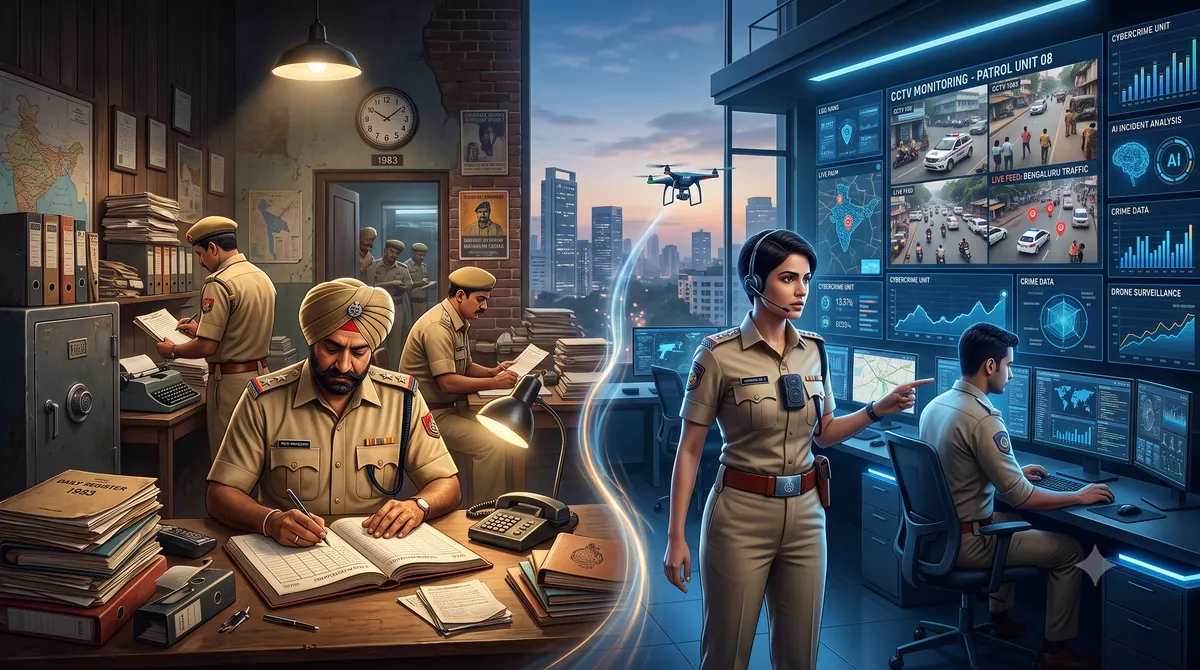
People now report crimes online, make digital payments, use social media daily, and store important information on smartphones. Along with these changes have come new challenges such as cybercrime, online fraud, identity theft, and digital harassment.
A policing system designed decades ago has to evolve to deal with these modern problems.
That's where police reforms come in.
One major area of reform is technology.
Across many states, police departments are adopting digital tools to improve efficiency. Online FIR services in selected cases, CCTV surveillance, cybercrime investigation units, digital record management, forensic technology, emergency response systems, and integrated communication networks are becoming increasingly common.
The goal isn't to replace police officers.
It's to help them respond faster, investigate better, and serve citizens more effectively.
Another important area is training.
Today's police personnel require skills that go far beyond physical fitness. They need to understand cybercrime, digital evidence, financial fraud, disaster management, community policing, and even communication with the public during emergencies.
As society changes, police training must also keep pace.
Recruitment is another topic often linked to police reforms.
Many states are working to fill vacancies, improve transparency in recruitment, strengthen examination security, and streamline selection processes. Fair recruitment helps ensure that capable candidates enter the police force through merit-based competition.
Public trust is equally important.
Modern policing is increasingly focused on building stronger relationships between officers and citizens. Community outreach programmes, women's help desks, emergency helplines, awareness campaigns, and victim support initiatives aim to make policing more approachable and responsive.
Technology is also transforming investigations.
Forensic science, DNA analysis, digital evidence, drone surveillance, automatic number plate recognition, and advanced crime analytics are becoming valuable tools in solving complex cases. These developments reduce dependence on traditional investigative methods and improve accuracy.
For aspirants, this evolution carries an important message.
Preparing for a police job today isn't only about clearing a written examination or passing a physical test.
It also means understanding the role of a modern police officer.
Future recruits may work with digital systems, cybercrime investigations, smart surveillance networks, and technology-driven policing methods that were almost unheard of a generation ago.
That makes continuous learning just as important as physical preparation.
It's also important to remember that reforms don't happen overnight.
Improving a policing system involves infrastructure, training, funding, technology, legal procedures, and administrative coordination. Different states may adopt reforms at different speeds based on their priorities and resources.
This is why discussions about police reforms appear in the news so often.
They're part of an ongoing effort to strengthen public safety, improve efficiency, and prepare law enforcement for future challenges.
For government job aspirants, staying informed about these developments offers two advantages.
First, police modernization is a common topic in competitive exams, interviews, and current affairs sections.
Second, it helps candidates understand the profession they're hoping to join.
After all, wearing the uniform is about much more than enforcing the law.
It's about protecting communities, adapting to new challenges, using technology responsibly, and earning the trust of the people.
Police reforms may begin as policy discussions.
But in the long run, they shape the future workplace of every police officer—and the future of public service itself.
Continue your preparation
Topics covered
About the author
Search Sarkari Naukri Team reviews government-job information, competitive-exam guidance and public-system explainers. Verify time-sensitive requirements on the relevant official authority's website.
Related articles
- What Happens When Your Dream Exam Is Not Your Best Opportunity? — Exam Culture & Society
- Is a Government Job Still the Best “Safe” Career Choice? — Careers & Society
- What Is a Gazetted Officer? And Why Their Signature Matters — Government Policies & Explained
- Why Do Aspirants Feel Guilty for Having a Backup Plan? — Exam Culture & Society
- Title: Why Does Preparing for a Government Job Sometimes Feel Like a Full-Time Job? — Exam Culture & Society
- What Does “Job Security” Actually Mean Anymore? — Work & Society