Title: Why Does Preparing for a Government Job Sometimes Feel Like a Full-Time Job?
By: Search Sarkari Naukri Team · Published: · Updated: · 6 min read
Quick summary
Preparing for a government exam can consume your entire day, month and sometimes years. But when preparation starts feeling like a job without a salary, where should ambition end and reality begin?
- Primary topic
- how to apply for railway job
- Category
- Exam Culture & Society
- Reading time
- 6 minutes
- Last reviewed
- 2026-09-09
What this guide covers
This article explains how to apply for railway job and closely related candidate questions.
- how to apply for railway job
- RRB NTPC 2026 preparation
- railway NTPC syllabus Hindi
You Wake Up Early. You Study All Day. You Take Tests. You Track Performance.
Sounds like a job, right?
Except there is no salary.
No paid leave.
No guaranteed promotion.
And at the end of the month, there is still no guarantee that all your effort will result in a selection.
That is the strange reality of competitive exam preparation.
For many aspirants, preparing for a government job eventually stops feeling like “studying for an exam.”
It becomes their full-time occupation.
And honestly, that changes everything.
Preparation Starts as a Goal. Then It Starts Taking Over Your Life.
In the beginning, the plan usually sounds simple.
“I'll prepare for one year.”
“I'll give my best.”
“If I clear it, great.”
If not, I'll figure something out.
Then one exam cycle passes.
Maybe the exam gets delayed.
Maybe you miss the cutoff by a few marks.
Maybe you clear one stage and fail at the next.
Maybe the vacancies are fewer than expected.
So you try again.
And again.
At some point, preparation is no longer something you do.
It becomes something you are.
You become:
“An SSC aspirant.”
“A banking aspirant.”
“A UPSC aspirant.”
“A railway aspirant.”
Your identity slowly gets attached to an exam result that has not even happened yet.
That can get dangerous.
A Full-Time Job Has Structure. Exam Preparation Often Doesn't.
This is one of the biggest problems.
A regular job usually gives you a structure.
You know when you start.
You know what you're responsible for.
You know what counts as progress.
You usually get paid for your time.
Exam preparation is much messier.
You can study for eight hours and still feel like you didn't do enough.
You can solve 200 questions and focus only on the 10 you got wrong.
You can improve your score and still miss the cutoff.
You can prepare seriously for months and lose because of one bad day.
So unlike many jobs, effort and outcome are not directly connected.
That uncertainty can mess with your head.
The Work Is Real. The Reward Is Uncertain.
Let's be clear about something.
Competitive exam preparation is not “doing nothing at home.”
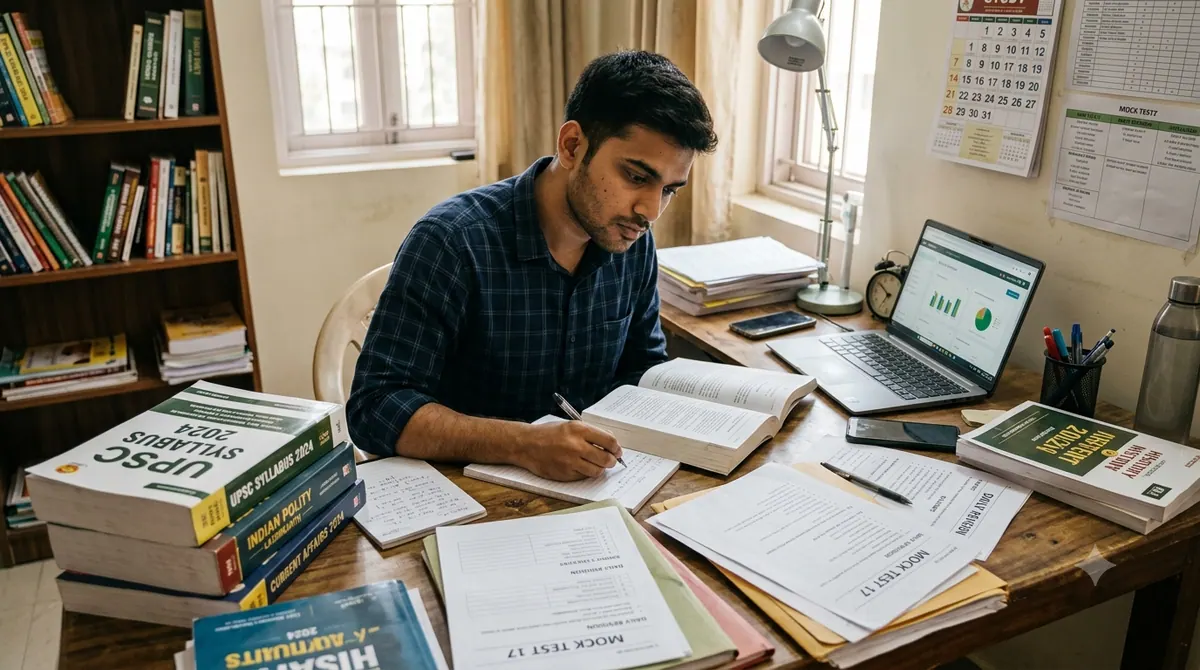
A serious aspirant may spend their day:
- Studying multiple subjects
- Revising old topics
- Giving mock tests
- Analysing mistakes
- Reading current affairs
- Tracking notifications
- Checking eligibility
- Managing documents
- Preparing for different exam patterns
That is real work.
The problem is not that aspirants aren't working.
The problem is that the system does not guarantee a reward for that work.
Two people can prepare equally hard.
One gets selected.
One doesn't.
That doesn't automatically mean one was intelligent and the other was lazy.
Competition is brutal.
Vacancies are limited.
Cutoffs can be extremely tight.
A few marks can completely change someone's result.
That's why preparation can become emotionally exhausting in a way people outside the process don't always understand.
The Dangerous Part: When You Stop Measuring Time
Ask some aspirants:
“How long have you been preparing?”
The answer might be:
“Since graduation.”
Okay.
What year did you graduate?
Silence.
That's when things get real.
There is nothing wrong with preparing for multiple attempts.
There is also nothing noble about preparing forever without asking whether your strategy is actually working.
This is where people confuse persistence with progress.
They are not the same thing.
Persistence means:
You keep showing up.
Progress means:
Something is actually improving.
Your score.
Your accuracy.
Your speed.
Your understanding.
Your strategy.
Your exam readiness.
If nothing has improved for a long time, simply studying more hours may not solve the problem.
Sometimes the plan itself needs to change.
More Hours Does Not Automatically Mean Better Preparation
This is another trap.
“Bro, I study 12 hours.”
Cool.
What did you actually learn?
Because 12 hours of distracted sitting is not some anime training arc.
Studying longer can help.
But effective preparation also depends on:
- Understanding the exam pattern
- Identifying weak areas
- Revising properly
- Practising previous-year questions
- Improving test-taking strategy
- Learning from mock test mistakes
An aspirant studying six focused hours can sometimes progress more than someone “studying” for twelve hours while constantly checking their phone, changing strategies and panicking about notifications.
Hours matter.
But feedback matters too.
Why Aspirants Feel Guilty About Taking a Break
Because when your competition is huge, resting can feel illegal.
You see someone online claiming:
“I study 14 hours every day.”
Someone else says:
“I completed the entire syllabus in three months.”
Another person posts their selection story.
Suddenly, taking Sunday off feels like career sabotage.
But preparation is a long process.
Burning yourself out doesn't automatically make you more serious.
You are not a machine.
If your concentration is dead, your mock scores are collapsing and you hate opening your books, pretending to be productive for another five hours may just be performance.
A break is not always laziness.
Sometimes it's maintenance.
Yes, discipline matters.
But “destroy your mental and physical routine to prove you're serious” is terrible advice.
The Bigger Problem Is That Life Keeps Moving
This is probably the hardest part.
While you prepare:
Friends get jobs.
Someone gets promoted.
Someone gets married.
Someone buys a bike.
Someone moves to another city.
And you're still waiting for an exam date.
Comparison becomes almost unavoidable.
You may know logically that everyone has a different timeline.
But emotionally?
That line doesn't always help.
Because you aren't comparing just salaries.
You're comparing movement.
Other people's lives appear to be moving forward.
Yours can feel stuck on “Result Awaited.”
That is why aspirants need something beyond exam preparation.
Not because you should give up.
Because your entire life should not remain paused until one PDF appears online.
Preparation Should Be Serious. Your Entire Identity Doesn't Have to Depend on It.
This is the balance more people need.
Prepare seriously.
Give yourself a proper routine.
Take exams seriously.
Track notifications.
Improve your performance.
But don't let one exam result become the only proof that your life is progressing.
Learn something useful outside your syllabus.
Build communication skills.
Understand technology.
Gain work experience if it makes sense for your situation.
Keep your documents and career options organised.
Stay connected to the world outside preparation.
A backup plan does not mean:
“I don't believe I can clear the exam.”
It means:
“My future is bigger than one result.”
Huge difference.
So Should Government Exam Preparation Be Treated Like a Full-Time Job?
For some aspirants, yes.
Especially when they have made a realistic decision based on their financial situation, exam timeline and preparation level.
But here's the important part:
A full-time effort needs full-time accountability.
Ask yourself regularly:
What am I preparing for?
Be specific.
Not just “government exams.”
Which exams?
What is my timeline?
Not “until I get selected.”
Give yourself review points.
Is my performance improving?
Check actual data, not vibes.
What happens if this attempt doesn't work?
Have a realistic answer.
Am I still choosing this path consciously?
Or am I continuing simply because I've already spent years on it?
That last question is uncomfortable.
But necessary.
The Goal Is Not to Study Forever. The Goal Is to Move Forward.
Preparation is supposed to be a bridge.
Not a permanent address.
There is nothing embarrassing about taking competitive exams seriously.
Millions of people want stable employment for completely rational reasons.
But seriousness should include self-awareness.
If you're giving your days, months or years to preparation, occasionally step back and ask:
“Is this process still taking me somewhere?”
If the answer is yes, continue with conviction.
If the answer is no, changing strategy is not failure.
Sometimes the bravest thing isn't trying harder.
It's being honest enough to change direction.
Continue Your Preparation
- Latest Government Jobs
- Daily Assessment
- Current Affairs
- Exam Calendar
- Digital Library
- Results
- Admit Cards
- All Blog Guides
Continue your preparation
Topics covered
About the author
Search Sarkari Naukri Team reviews government-job information, competitive-exam guidance and public-system explainers. Verify time-sensitive requirements on the relevant official authority's website.
Related articles
- Age Limit for Government Jobs 2026: Rules, Relaxation & How to Check — Government Job Guides
- Can Government Employees Start a YouTube Channel or Business? Rules Explained — Government Policies & Explained
- 10th and 12th Pass Government Jobs in India 2026: Best Career Options, Salary & How to Apply — Career Guide
- Bank Apprentice Jobs 2026: Graduate Apprentice Apply Guide — Government Job Guides
- Government Jobs Without Graduation 2026 – 10th & 12th Pass Jobs — Government Job Guides
- Group A, B, C & D Government Jobs Explained: Which One Is Right for You? — Career Guide
More in Exam Culture & Society →