Government Policies & Explained
UPI Charges From October 15, 2026 – New 0.4% MDR Rule, Exemptions & What Users Need to Know
By: Search Sarkari Naukri Editorial Team · Published: · Updated: · 12 min read
Quick summary
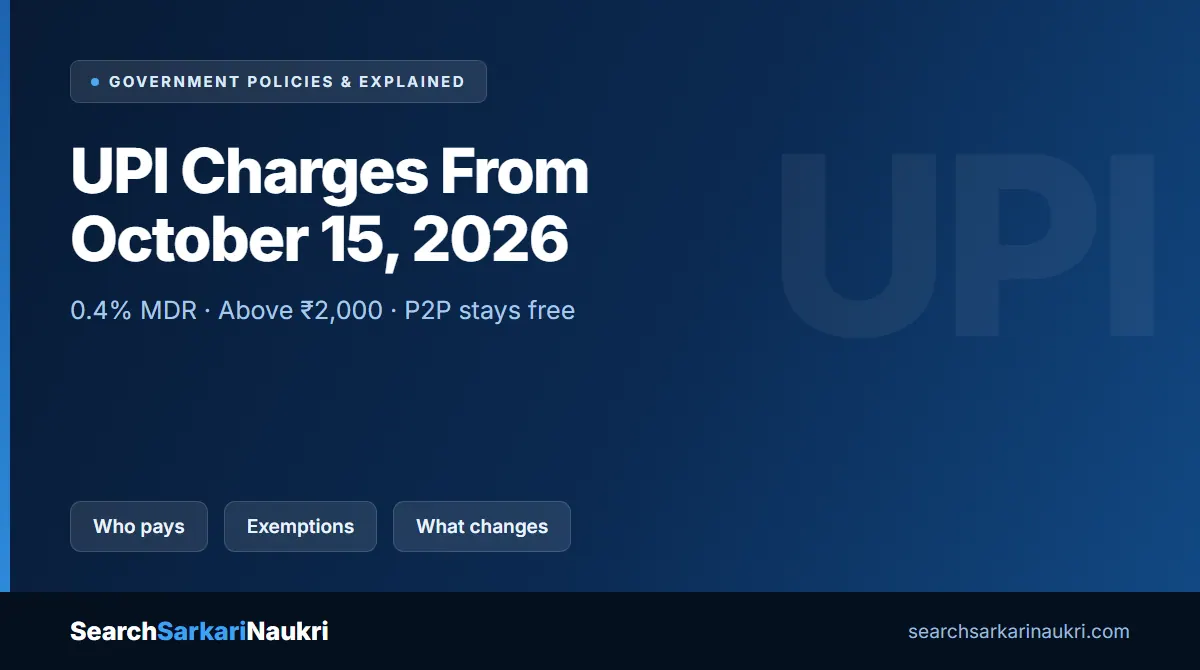
UPI is set to see a major change from October 15, 2026, with the introduction of a Merchant Discount Rate (MDR) on certain higher-value Person-to-Merchant (P2M) transactions. Under the notified framework, a 0.4% MDR will apply to eligible UPI merchant transactions above ₹2,000, subject to a maximum charge of ₹300 per transaction.
- Primary topic
- UPI charges
- Category
- Government Policies & Explained
- Reading time
- 12 minutes
- Last reviewed
- 2026-10-05
UPI is set to see a major change from October 15, 2026, with the introduction of a Merchant Discount Rate (MDR) on certain higher-value Person-to-Merchant (P2M) transactions. Under the notified framework, a 0.4% MDR will apply to eligible UPI merchant transactions above ₹2,000, subject to a maximum charge of ₹300 per transaction.
Will UPI payments be charged from October 15, 2026? Not all UPI payments will be charged. The new MDR framework applies primarily to eligible P2M UPI transactions above ₹2,000. Person-to-person (P2P) UPI transfers remain free, and UPI P2M transactions up to ₹2,000 remain outside the charge framework. Certain small merchants and specified categories also receive separate treatment.
What Is the New UPI MDR Rule From October 15, 2026?
The National Payments Corporation of India (NPCI) has notified a revised merchant-fee framework for eligible UPI merchant transactions. The key change is a 0.4% Merchant Discount Rate (MDR) on applicable P2M UPI payments above ₹2,000.
For example, if an eligible merchant receives a ₹10,000 UPI payment, 0.4% of ₹10,000 is ₹40. However, this does not automatically mean the customer pays ₹10,040. The MDR is a merchant/payment-ecosystem charge, and the actual customer-facing pricing depends on the applicable commercial and regulatory arrangements.
The ₹300 maximum applies to the standard applicable category once 0.4% would exceed that amount.
Who Will Pay the UPI MDR?
The new MDR is structured as a merchant-side charge. This means the charge is associated with the merchant/payment ecosystem rather than being a blanket transaction fee directly imposed on every UPI customer.
The government and NPCI have stated that consumers should continue to be able to use UPI without a general transaction charge, while the new framework applies to specified merchant payments. However, businesses may have different commercial arrangements with their payment providers, so users should not assume that every merchant's pricing or payment experience will be identical.
Which UPI Transactions Will Remain Free?
Several important categories remain outside the new standard MDR.
Person-to-Person UPI Payments
If you transfer money from your UPI account to another person's bank account, the new P2M MDR does not apply. For example, sending ₹5,000 to a friend or transferring money to a family member are P2P transactions and remain outside the merchant MDR framework.
UPI Merchant Payments Up to ₹2,000
P2M UPI transactions up to ₹2,000 remain free under the notified framework. This means a customer paying ₹500, ₹1,000 or ₹2,000 to an eligible merchant does not become subject to the new 0.4% MDR simply because the payment is made through UPI.
Eligible Small Merchants
The framework also provides protection for specified small merchants receiving UPI payments through QR codes. Reports on the NPCI framework describe Person-to-Person Merchant (P2PM) treatment for qualifying small merchants, including small vendors such as certain kirana stores, street vendors and similar businesses. Eligibility depends on the applicable criteria and transaction arrangements.
Which UPI Payments Above ₹2,000 Can Attract 0.4% MDR?
The standard 0.4% MDR, capped at ₹300, applies to eligible P2M transactions above ₹2,000 that fall under the general merchant category. For example, if an eligible merchant receives a ₹10,000 UPI payment, 0.4% of ₹10,000 is ₹40. This does not automatically mean the customer pays ₹10,040. The MDR is a merchant/payment-ecosystem charge.
Special UPI Categories With Different MDR Treatment
The new framework is not simply a single 0.4% rate for every payment above ₹2,000. Certain sectors have separate treatment.
Railways, Telecom, Insurance and Fuel
For specified categories including Railways, Telecom services, Insurance, and Fuel, a flat ₹5 MDR applies to eligible transactions above ₹2,000 rather than the standard 0.4% structure. For example, a qualifying ₹10,000 transaction in one of these specified categories would attract the applicable ₹5 MDR rather than ₹40 under the standard 0.4% calculation.
Capital Market Payments
Capital-market-related transactions receive separate treatment. Transactions involving areas such as Mutual funds, Stockbrokers, Dealers, and Securities firms can attract a 0.02% MDR, subject to a ₹300 cap. This is substantially different from the standard 0.4% merchant rate.
Electricity and Other Utility Payments
Specified public-utility categories also receive separate treatment. The reported framework includes categories such as Electricity, Municipal water, and Piped natural gas. Certain qualifying payments above ₹2,000 can fall under the ₹5 flat MDR structure rather than the standard 0.4% rate.
Does the Customer Have to Pay the 0.4% UPI Charge?
The new MDR is not designed as a general consumer transaction tax. The notified framework places the MDR within the merchant/payment ecosystem. The government's position, as reported after the notification, is that ordinary consumers should not be broadly charged for using UPI. NPCI has also said that the revised framework is intended to support the sustainability of the UPI ecosystem.
However, merchants and payment providers may have different commercial arrangements. Therefore, users should check the final amount displayed before confirming a payment.
Is the New UPI MDR a Tax?
No. MDR and tax are not the same thing. MDR stands for Merchant Discount Rate. It is a fee associated with processing a merchant payment and distributing revenue across relevant participants in the payment ecosystem. A tax is a compulsory government levy. The new UPI framework is therefore more accurately described as a merchant payment-processing fee/MDR framework, rather than a general tax on UPI users.
Why Is UPI MDR Being Introduced?
UPI has grown into one of India's largest digital-payment systems. According to recent reporting, UPI processed about 24.51 billion transactions worth ₹29.90 lakh crore in August 2026. Operating a payment network at this scale involves banking infrastructure, payment servers, network capacity, cybersecurity, fraud monitoring, software infrastructure, transaction processing, system upgrades, and merchant and bank integration.
NPCI has argued that the ecosystem requires sustainable funding for infrastructure, cybersecurity and continued innovation. The revised MDR framework is intended to create a revenue mechanism for selected higher-value merchant transactions while continuing to protect low-value digital payments and qualifying small merchants.
What Does This Mean for Small Shopkeepers?
For many small merchants, the important point is that the new rule is not simply a blanket 0.4% fee on every UPI payment. Qualifying small merchants receive specific protection under the framework. A small vendor receiving low-value UPI payments should therefore not assume that every transaction above ₹2,000 automatically means a 0.4% deduction.
Merchants should check with their acquiring bank, UPI payment provider, payment aggregator, or merchant QR provider to understand how their specific merchant category is classified.
What Does This Mean for Large Businesses?
Large merchants that process substantial numbers of high-value UPI transactions may see changes in payment-processing costs. Businesses should review merchant category classification, UPI acquiring agreement, payment aggregator terms, reconciliation reports, accounting treatment, payment gateway/QR configuration, customer-facing payment flows, and refund and settlement processes.
Businesses should also avoid automatically adding a separate "UPI fee" to customer bills without checking applicable rules and contractual arrangements.
UPI Charges vs P2P Transfers: Simple Example
Consider two different transactions.
Example 1: Sending money to a friend You send ₹10,000 to your friend using UPI. Transaction type: P2P New merchant MDR: Not applicable.
Example 2: Paying a business You pay ₹10,000 to an eligible merchant. Transaction type: P2M Potential standard MDR: 0.4% Illustrative MDR: ₹40 Maximum standard MDR: ₹300
The two transactions should not be treated in the same way simply because both use UPI.
What Happens to UPI Payments of ₹2,000 or Less?
The framework specifically protects UPI transactions up to ₹2,000 from direct or indirect charges under the relevant notification. This is particularly important for everyday payments such as food purchases, local shopping, small retail payments, transport, small service payments, and routine household purchases. The government has stated that the vast majority of low-value merchant transactions will remain free.
Will Google Pay, PhonePe and Other UPI Apps Start Charging Everyone?
There is no basis for saying that all users of Google Pay, PhonePe, Paytm or other UPI applications will suddenly be charged a 0.4% fee for every UPI payment. The announced framework concerns eligible merchant transactions and does not impose a universal 0.4% consumer fee on all UPI transfers. Individual apps may communicate their own merchant-side arrangements, so users should rely on the actual payment screen and official communication rather than social-media claims.
What Should UPI Users Do?
For ordinary users, no major change is required for routine low-value or P2P transactions. Before making a high-value merchant payment:
- Check the merchant name
- Check the final amount displayed in the UPI app
- Confirm that you are paying the intended business
- Do not approve an unexpected additional amount without understanding it
- Keep the transaction receipt
- Contact the bank/app if an unexpected charge appears
- Avoid clicking UPI payment links received through suspicious messages
UPI Safety Tips After the New MDR Rule
The introduction of MDR does not change basic UPI security practices. Remember:
- Never share your UPI PIN
- A legitimate payment does not require you to reveal your UPI PIN to another person
- Verify the recipient before approving a payment
- Do not install unknown remote-access applications at someone's request
- Do not scan a QR code merely to "receive" money unless you understand the transaction
- Be careful with fake refund messages
- Do not click suspicious payment links
- Check your bank statement if a transaction looks unusual
A new fee rule can also create opportunities for fraudsters to send fake messages claiming that users must "pay UPI activation charges" or "pay ₹300 to keep UPI active." Such messages should be treated cautiously.
Key UPI MDR Rules From October 15, 2026
| Rule | Treatment |
|---|---|
| P2P UPI payment | Free |
| P2M payment up to ₹2,000 | Free |
| Eligible standard P2M above ₹2,000 | 0.4% MDR |
| Standard MDR maximum | ₹300 |
| Railways/telecom/insurance/fuel specified categories | ₹5 flat MDR |
| Certain capital-market transactions | 0.02%, capped at ₹300 |
| Qualifying small merchants | Separate exemption/protection |
| Start date | October 15, 2026 |
| General consumer UPI tax | No |
| Every UPI transaction charged 0.4% | No |
The exact classification of a payment remains important, so merchants should verify their category and payment-provider terms.
UPI Charges 2026: Important Dates
August 2026: UPI continued to operate under the existing zero-MDR framework while the policy and legislative changes were being developed.
August 11, 2026: Parliament passed the relevant amendment enabling the legal framework for charges on specified digital payment modes.
September 14, 2026: The relevant government notification provided the framework concerning charges on specified digital payments and protections for low-value UPI transactions.
October 15, 2026: The new MDR framework is scheduled to take effect.
Frequently Asked Questions About UPI Charges 2026
Is UPI going to be charged from October 15, 2026?
Not universally. The new MDR framework applies to specified merchant transactions, particularly eligible P2M payments above ₹2,000.
Is 0.4% UPI charge applicable to customers?
The 0.4% MDR is structured as a merchant-side payment-processing charge. It is not a general 0.4% tax on consumers.
Will UPI payments below ₹2,000 remain free?
Yes. P2M UPI payments up to ₹2,000 remain protected from the applicable charge under the notified framework.
Will UPI transfers between two people be charged?
No. P2P UPI transactions remain outside the new merchant MDR.
What is the maximum UPI MDR?
For the standard 0.4% category, the MDR is capped at ₹300 per transaction.
What happens to a ₹75,000 UPI merchant payment?
Under the standard 0.4% category, 0.4% of ₹75,000 is ₹300, which reaches the stated cap.
What happens above ₹75,000?
For the standard category, the MDR remains capped at ₹300 rather than continuing to increase at 0.4%.
Is UPI MDR the same as GST?
No. MDR is a merchant/payment-processing fee. It should not automatically be described as GST or a new consumer tax.
Will PhonePe and Google Pay charge users 0.4%?
The new framework does not mean that all users of UPI apps will be charged 0.4% on every payment.
Are small merchants exempt?
Qualifying small merchants receive separate protection under the framework. The precise eligibility conditions should be checked with the merchant's bank/payment provider.
Why has NPCI introduced MDR?
The stated rationale includes supporting the sustainability of the UPI payment ecosystem and funding infrastructure, cybersecurity and innovation.
Is the UPI charge a new tax?
No. The terminology is Merchant Discount Rate (MDR), not a general UPI tax.
Important: Don't Believe Every Viral UPI Message
Following the announcement, users may encounter messages such as "UPI will now charge everyone 0.4%." That statement is incomplete and misleading. The new framework distinguishes between P2P and P2M payments, payments below and above ₹2,000, small and other merchants, standard merchant categories, special sectors, and capital-market transactions. Therefore, users should check the official framework rather than relying on screenshots, forwarded WhatsApp messages or social-media posts.
What Merchants Should Check Before October 15
Businesses accepting UPI should review their payment setup before the implementation date. Merchant checklist includes:
- Check your merchant category
- Contact your acquiring bank
- Confirm the applicable MDR
- Review payment aggregator agreements
- Check settlement reports
- Update accounting/reconciliation systems
- Test high-value UPI transactions
- Review invoices and payment receipts
- Check refund handling
- Train billing staff
- Do not communicate an additional customer charge unless it is permitted and properly disclosed
Final Takeaway
The October 15, 2026 UPI change does not mean that UPI will stop being free for everyone. The major change is the introduction of MDR on specified higher-value merchant payments. The standard framework includes 0.4% MDR on eligible P2M UPI transactions above ₹2,000, capped at ₹300. At the same time, P2P UPI payments remain free, P2M payments up to ₹2,000 remain free, qualifying small merchants receive protection, certain sectors have a ₹5 flat MDR, certain capital-market transactions have a separate lower MDR, and the new MDR should not be confused with a universal consumer tax.
For consumers, the most important point is to check the final payment amount and rely on official information rather than viral claims. For merchants, the key action is to confirm their exact MDR category with their acquiring bank or payment provider before October 15, 2026.
For government-job aspirants, this is a relevant banking, economy, fintech and current-affairs topic that may be useful for competitive-exam preparation. Candidates preparing for banking and government exams can track current recruitment and examination updates through the latest government jobs section. You can also use the eligibility checker to review government-exam eligibility. For Maharashtra-specific recruitment, see the Maharashtra Government Jobs 2026 guide. Candidates looking for Pune opportunities can also check government jobs in Pune.
Frequently asked questions
What Is the New UPI MDR Rule From October 15, 2026?
The National Payments Corporation of India (NPCI) has notified a revised merchant-fee framework for eligible UPI merchant transactions. The key change is a 0.4% Merchant Discount Rate (MDR) on applicable P2M UPI payments above ₹2,000. For example, if an eligible merchant receives a ₹10,000 UPI payment, 0.4% of ₹10,000 is ₹40. However, this does not automatically mean the customer pays ₹10,040. The MDR is a merchant/p
Who Will Pay the UPI MDR?
The new MDR is structured as a merchant-side charge. This means the charge is associated with the merchant/payment ecosystem rather than being a blanket transaction fee directly imposed on every UPI customer. The government and NPCI have stated that consumers should continue to be able to use UPI without a general transaction charge, while the new framework applies to specified merchant payments. However, businesses
Which UPI Transactions Will Remain Free?
Several important categories remain outside the new standard MDR.
Which UPI Payments Above ₹2,000 Can Attract 0.4% MDR?
The standard 0.4% MDR, capped at ₹300, applies to eligible P2M transactions above ₹2,000 that fall under the general merchant category. For example, if an eligible merchant receives a ₹10,000 UPI payment, 0.4% of ₹10,000 is ₹40. This does not automatically mean the customer pays ₹10,040. The MDR is a merchant/payment-ecosystem charge.
Does the Customer Have to Pay the 0.4% UPI Charge?
The new MDR is not designed as a general consumer transaction tax. The notified framework places the MDR within the merchant/payment ecosystem. The government's position, as reported after the notification, is that ordinary consumers should not be broadly charged for using UPI. NPCI has also said that the revised framework is intended to support the sustainability of the UPI ecosystem. However, merchants and payment
Is the New UPI MDR a Tax?
No. MDR and tax are not the same thing. MDR stands for Merchant Discount Rate. It is a fee associated with processing a merchant payment and distributing revenue across relevant participants in the payment ecosystem. A tax is a compulsory government levy. The new UPI framework is therefore more accurately described as a merchant payment-processing fee/MDR framework, rather than a general tax on UPI users.
Why Is UPI MDR Being Introduced?
UPI has grown into one of India's largest digital-payment systems. According to recent reporting, UPI processed about 24.51 billion transactions worth ₹29.90 lakh crore in August 2026. Operating a payment network at this scale involves banking infrastructure, payment servers, network capacity, cybersecurity, fraud monitoring, software infrastructure, transaction processing, system upgrades, and merchant and bank inte
What Does This Mean for Small Shopkeepers?
For many small merchants, the important point is that the new rule is not simply a blanket 0.4% fee on every UPI payment. Qualifying small merchants receive specific protection under the framework. A small vendor receiving low-value UPI payments should therefore not assume that every transaction above ₹2,000 automatically means a 0.4% deduction. Merchants should check with their acquiring bank, UPI payment provider,
What Does This Mean for Large Businesses?
Large merchants that process substantial numbers of high-value UPI transactions may see changes in payment-processing costs. Businesses should review merchant category classification, UPI acquiring agreement, payment aggregator terms, reconciliation reports, accounting treatment, payment gateway/QR configuration, customer-facing payment flows, and refund and settlement processes. Businesses should also avoid automati
What Happens to UPI Payments of ₹2,000 or Less?
The framework specifically protects UPI transactions up to ₹2,000 from direct or indirect charges under the relevant notification. This is particularly important for everyday payments such as food purchases, local shopping, small retail payments, transport, small service payments, and routine household purchases. The government has stated that the vast majority of low-value merchant transactions will remain free.
Continue your preparation
Topics covered
About the author
Search Sarkari Naukri Editorial Team reviews government-job information, competitive-exam guidance and public-system explainers. Verify time-sensitive requirements on the relevant official authority's website.
Related articles
- Can Government Employees Start a YouTube Channel or Business? Rules Explained — Government Policies & Explained
- What Is the Right to Information (RTI) Act? How Citizens Can Seek Government Information — Government Policies & Explained
- Government Job Salary Explained: What You Actually Take Home Every Month — Salary & Benefits
- 7th Pay Commission Explained: What Every Government Job Aspirant Should Know — Salary & Benefits
- 12th Pass Sarkari Naukri 2026: Jobs, Eligibility & How to Apply — Government Job Guides
- Age Limit for Government Jobs 2026: Rules, Relaxation & How to Check — Government Job Guides
More in Government Policies & Explained →