How Laws Are Made in India: From Bill to Act Explained
By: Search Sarkari Naukri Team · Published: · Updated: · 4 min read
Quick summary
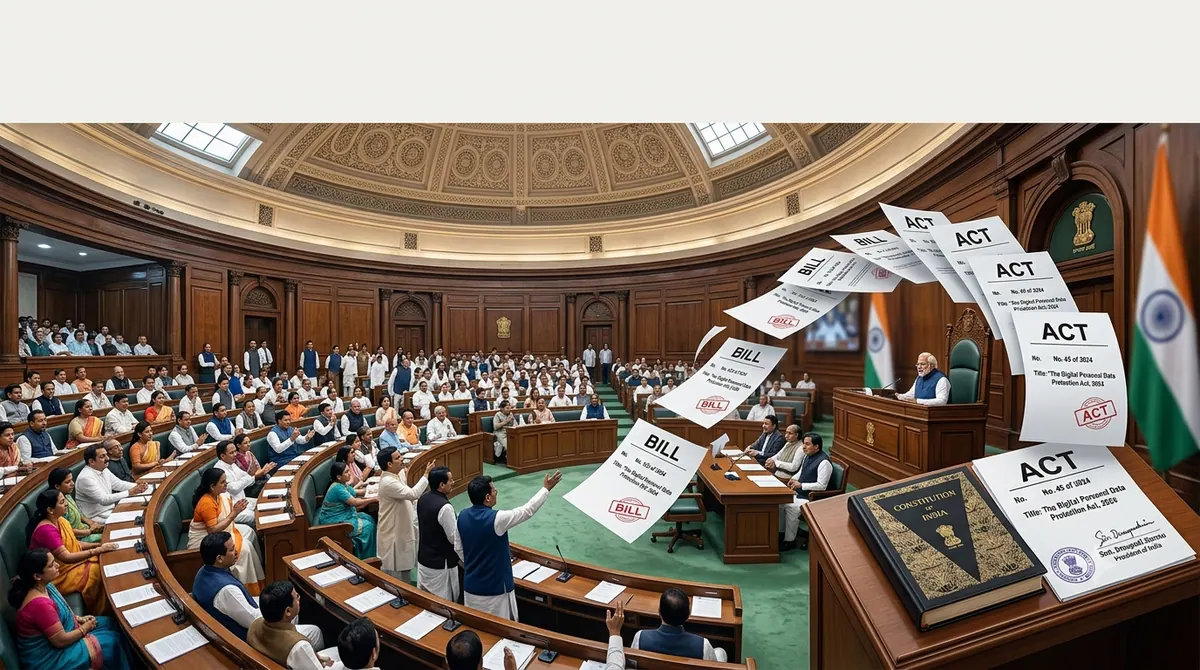
Ever wondered how a law is created in India? Learn how a proposal becomes a Bill, passes through Parliament, receives the President's approval, and officially becomes an Act.
- Primary topic
- how laws are made in India
- Category
- Government System
- Reading time
- 4 minutes
- Last reviewed
- 2026-08-20
How Laws Are Made in India: From Bill to Act Explained
Every day, governments introduce new rules and laws that affect millions of people. Whether it's traffic regulations, tax reforms, education policies, or environmental protection, every law in India follows a structured legal process before it comes into force.
Many people hear terms like Bill, Act, or Parliament, but few know what they actually mean or how a proposal becomes an official law.
Understanding this process not only helps citizens become more informed but is also useful for students preparing for competitive examinations like UPSC, SSC, Banking, Railways, and State PSCs.
Let's understand how laws are made in India in simple language.
What Is a Bill?
A Bill is simply a proposal for a new law or for changing an existing law.
Before any rule becomes legally enforceable, it first exists as a Bill.
Bills may be introduced to:
Create a completely new law. Amend an existing law. Repeal an outdated law. Address new social, economic, or technological challenges.
In simple terms, every Act starts as a Bill, but not every Bill becomes an Act.
Who Can Introduce a Bill?
Most Bills are introduced by the Central Government through a minister.
These are known as Government Bills.
However, Members of Parliament who are not ministers can also introduce Bills. These are called Private Members' Bills.
Although Government Bills are far more likely to become law, Private Members' Bills often help generate discussion on important public issues.
The First Reading
Once a Bill is introduced in either the Lok Sabha or the Rajya Sabha, it goes through what is known as the First Reading.
During this stage:
The Bill is formally introduced. Its title and objectives are presented. Copies are made available to Members of Parliament.
Usually, there is little detailed discussion during this stage.
Committee Examination
Many important Bills are referred to Parliamentary Committees for detailed examination.
These committees carefully study the proposal by:
Examining each provision. Consulting experts. Inviting public suggestions when necessary. Reviewing legal and administrative implications.
Committee scrutiny often improves the quality of legislation before it returns to Parliament.
The Second Reading
The Second Reading is one of the most important stages.
Members of Parliament debate the Bill in detail.
During these discussions, MPs may:
Support the proposal. Suggest amendments. Raise concerns. Recommend improvements.
Each clause may be discussed separately before voting takes place.
This stage ensures that different viewpoints are considered before a law is approved.
Voting in the First House
After the debate is completed, Members vote on the Bill.
If the required majority supports it, the Bill is considered passed by the House in which it was introduced.
If it fails to receive sufficient support, the Bill does not proceed further.
The Second House
Once approved by one House, the Bill is sent to the other House of Parliament.
The second House follows a similar process.
It may:
Approve the Bill. Suggest amendments. Reject it. Delay consideration in certain situations.
If amendments are proposed, both Houses may need to agree on the final version before the Bill can move forward.
What Happens If Both Houses Disagree?
Sometimes, the Lok Sabha and Rajya Sabha may disagree on a Bill.
For certain types of Bills, the Constitution allows the President to summon a Joint Sitting of both Houses.
During the Joint Sitting, Members from both Houses debate and vote together to resolve the disagreement.
However, this procedure is used only in specific situations and is relatively uncommon.
President's Assent
Once both Houses of Parliament approve a Bill, it is sent to the President of India.
The President may:
Give assent. Return certain Bills for reconsideration (except Money Bills). Take other constitutionally permitted actions depending on the type of Bill.
When the President gives assent, the Bill officially becomes an Act of Parliament.
This is the stage at which the proposed legislation becomes law.
When Does the Law Come Into Effect?
Not every law becomes effective immediately after receiving Presidential assent.
Some Acts come into force on the same day.
Others become effective on a future date specified within the Act or through a government notification.
This allows governments time to prepare rules, appoint authorities, or establish administrative systems before implementation.
Bill vs Act: What's the Difference?
People often use these terms interchangeably, but they have different meanings.
A Bill is a proposal that is still under consideration.
An Act is a law that has successfully completed the legislative process and received Presidential assent.
Simply put:
Bill = Proposed Law Act = Official Law Why Is This Process Important?
Making laws is one of Parliament's most important responsibilities.
The multi-stage process ensures that laws are not passed hastily.
Debates, committee reviews, amendments, and voting allow different opinions to be considered before legislation affects millions of citizens.
This process also reflects the democratic principle that laws should be carefully examined rather than decided by a single individual or institution.
Can Laws Be Changed Later?
Yes.
Laws are not permanent.
If circumstances change or improvements are needed, Parliament can amend or repeal existing Acts by following the legislative process again.
Many important Indian laws have been amended multiple times to address changing social, technological, and economic needs.
Frequently asked questions
What Is a Bill?
A Bill is simply a proposal for a new law or for changing an existing law. Before any rule becomes legally enforceable, it first exists as a Bill. Bills may be introduced to: Create a completely new law. Amend an existing law. Repeal an outdated law. Address new social, economic, or technological challenges. In simple terms, every Act starts as a Bill, but not every Bill becomes an Act.
Who Can Introduce a Bill?
Most Bills are introduced by the Central Government through a minister. These are known as Government Bills. However, Members of Parliament who are not ministers can also introduce Bills. These are called Private Members' Bills. Although Government Bills are far more likely to become law, Private Members' Bills often help generate discussion on important public issues.
What Happens If Both Houses Disagree?
Sometimes, the Lok Sabha and Rajya Sabha may disagree on a Bill. For certain types of Bills, the Constitution allows the President to summon a Joint Sitting of both Houses. During the Joint Sitting, Members from both Houses debate and vote together to resolve the disagreement. However, this procedure is used only in specific situations and is relatively uncommon.
When Does the Law Come Into Effect?
Not every law becomes effective immediately after receiving Presidential assent. Some Acts come into force on the same day. Others become effective on a future date specified within the Act or through a government notification. This allows governments time to prepare rules, appoint authorities, or establish administrative systems before implementation.
Bill vs Act: What's the Difference?
People often use these terms interchangeably, but they have different meanings. A Bill is a proposal that is still under consideration. An Act is a law that has successfully completed the legislative process and received Presidential assent. Simply put: Bill = Proposed Law Act = Official Law Why Is This Process Important? Making laws is one of Parliament's most important responsibilities. The multi-stage process ensu
Can Laws Be Changed Later?
Yes. Laws are not permanent. If circumstances change or improvements are needed, Parliament can amend or repeal existing Acts by following the legislative process again. Many important Indian laws have been amended multiple times to address changing social, technological, and economic needs.
Continue your preparation
Topics covered
About the author
Search Sarkari Naukri Team reviews government-job information, competitive-exam guidance and public-system explainers. Verify time-sensitive requirements on the relevant official authority's website.
Related articles
- Can a Government Employee Be Transferred Against Their Will? The Rules Explained — Government System
- What Happens When Your Dream Exam Is Not Your Best Opportunity? — Exam Culture & Society
- Is a Government Job Still the Best “Safe” Career Choice? — Careers & Society
- What Is a Gazetted Officer? And Why Their Signature Matters — Government Policies & Explained
- Why Do Aspirants Feel Guilty for Having a Backup Plan? — Exam Culture & Society
- Title: Why Does Preparing for a Government Job Sometimes Feel Like a Full-Time Job? — Exam Culture & Society