How India's District Administration Works: Collector, SP, CEO, Tehsildar & More Explained
By: Search Sarkari Naukri Team · Published: · Updated: · 4 min read
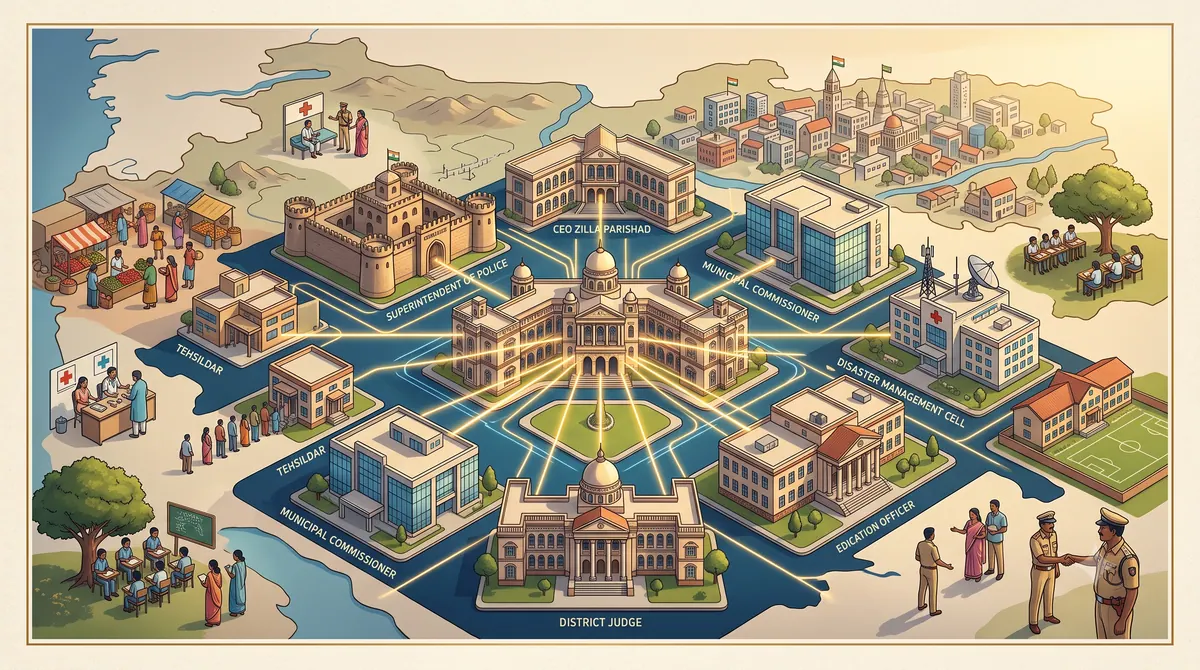
Quick summary
Have you ever wondered who actually runs a district in India? Is it the Collector, the SP, the CEO of the Zilla Parishad, or someone else? Here's a simple guide to understanding how India's district administration works—and why every government job aspirant should know it.
- Primary topic
- District Administration
- Category
- Government System
- Reading time
- 4 minutes
- Last reviewed
- 2026-08-20
Imagine waking up tomorrow to find that an entire district has lost electricity after a powerful storm.
Roads are blocked.
Schools are closed.
Hospitals need emergency supplies.
People are calling helplines for help.
Who takes charge?
Many people would immediately answer, "The Collector."
They're not wrong—but they're not completely right either.
A district doesn't run because of one powerful officer. It functions because dozens of departments work together like the gears of a giant machine. Every officer has a specific role, and understanding this system is one of the most valuable pieces of knowledge for anyone preparing for government jobs.
Let's take a tour of the district administration.
The District Collector (or District Magistrate)
Think of the District Collector as the administrative captain of the district.
Traditionally responsible for revenue collection—hence the title "Collector"—the role has evolved into one of the most influential positions in district administration. Today, the Collector coordinates development projects, oversees elections, manages disaster response, monitors law and order from an administrative perspective, implements government schemes, and ensures different departments work together.
When floods, droughts, epidemics, or other emergencies occur, the Collector often leads the district's overall administrative response.
The Superintendent of Police (SP)
If the Collector manages administration, the Superintendent of Police (SP) leads policing.
The SP is responsible for maintaining law and order, preventing crime, supervising police stations, managing investigations, providing security during major events, and ensuring public safety.
Although the Collector and SP frequently coordinate, they belong to different services and perform different functions. One focuses on civil administration, while the other leads law enforcement.
The Chief Executive Officer (CEO), Zilla Parishad
While the Collector oversees the district as a whole, the CEO of the Zilla Parishad focuses primarily on rural development.
The CEO supervises schemes related to village infrastructure, education, sanitation, drinking water, health programmes, agriculture, and rural employment. Much of the government's development work in villages passes through the Zilla Parishad.
If you've heard of roads being built in villages or schools receiving new facilities, chances are the Zilla Parishad played an important role.
The Sub-Divisional Magistrate (SDM)
Large districts are divided into subdivisions to make administration more efficient.
Each subdivision is headed by an SDM, who handles revenue matters, executive magistrate duties, disaster management, election work, and administrative coordination within that subdivision.
You can think of the SDM as helping the Collector manage a smaller section of the district.
The Tehsildar
The Tehsildar is one of the most important officers for everyday public services.
Land records, mutation entries, revenue collection, income certificates, caste certificates, domicile certificates, and many property-related issues are processed through the Tehsil office.
For many citizens, the Tehsildar is the government official they interact with most frequently.
Municipal Commissioner or Chief Officer
In urban areas, civic services are handled by municipal bodies.
The Municipal Commissioner (or Chief Officer in smaller municipalities) manages roads, street lighting, drainage, waste collection, public sanitation, water supply, parks, and other urban services.
If a city road is repaired or garbage collection improves, the municipal administration is usually involved.
District-Level Officers
A district is also home to specialists who lead individual departments.
The District Health Officer oversees public health programmes, vaccination drives, disease control, and government hospitals.
The District Education Officer monitors schools, teachers, examinations, and educational initiatives.
The Agriculture Officer supports farmers through modern farming practices, crop advisory services, and government schemes.
Similarly, departments such as social welfare, women and child development, public works, transport, food and civil supplies, industries, and forests all have district-level officers responsible for their respective fields.
How Do They Work Together?
No officer works in isolation.
Suppose heavy rainfall causes flooding in several villages.
The Collector coordinates the overall response.
The SP manages evacuation routes, traffic, and public safety.
The Health Department establishes medical camps.
The Public Works Department clears damaged roads.
The Zilla Parishad mobilizes village-level resources.
The Food and Civil Supplies Department distributes essential commodities.
Every department contributes to solving the same problem from a different angle.
That's what makes district administration effective.
Why Should Aspirants Understand This?
Whether you're preparing for UPSC, MPSC, SSC, Police Recruitment, Talathi, Gram Sevak, or other government examinations, questions about district administration appear regularly in both written exams and interviews.
But beyond examinations, understanding this system helps you appreciate how public services actually reach citizens.
When a new school opens, a vaccination drive begins, disaster relief reaches affected families, or elections are conducted smoothly, it's rarely the work of one individual.
It's the result of coordination between dozens of dedicated public servants.
A district may appear to be governed by a single office.
In reality, it's powered by an entire network of officers working behind the scenes.
And once you understand that network, government administration becomes much easier—and much more fascinating—to understand.
Frequently asked questions
Who takes charge?
Many people would immediately answer, "The Collector." They're not wrong—but they're not completely right either. A district doesn't run because of one powerful officer. It functions because dozens of departments work together like the gears of a giant machine. Every officer has a specific role, and understanding this system is one of the most valuable pieces of knowledge for anyone preparing for government jobs. Let
How Do They Work Together?
No officer works in isolation. Suppose heavy rainfall causes flooding in several villages. The Collector coordinates the overall response. The SP manages evacuation routes, traffic, and public safety. The Health Department establishes medical camps. The Public Works Department clears damaged roads. The Zilla Parishad mobilizes village-level resources. The Food and Civil Supplies Department distributes essential commo
Why Should Aspirants Understand This?
Whether you're preparing for UPSC, MPSC, SSC, Police Recruitment, Talathi, Gram Sevak, or other government examinations, questions about district administration appear regularly in both written exams and interviews. But beyond examinations, understanding this system helps you appreciate how public services actually reach citizens. When a new school opens, a vaccination drive begins, disaster relief reaches affected f
Continue your preparation
Topics covered
About the author
Search Sarkari Naukri Team reviews government-job information, competitive-exam guidance and public-system explainers. Verify time-sensitive requirements on the relevant official authority's website.
Related articles
- Can a Government Employee Be Transferred Against Their Will? The Rules Explained — Government System
- What Happens When Your Dream Exam Is Not Your Best Opportunity? — Exam Culture & Society
- Is a Government Job Still the Best “Safe” Career Choice? — Careers & Society
- What Is a Gazetted Officer? And Why Their Signature Matters — Government Policies & Explained
- Why Do Aspirants Feel Guilty for Having a Backup Plan? — Exam Culture & Society
- Title: Why Does Preparing for a Government Job Sometimes Feel Like a Full-Time Job? — Exam Culture & Society