Has Coaching Become a Second Education System in India?
By: Search Sarkari Naukri Team · Published: · Updated: · 8 min read
Quick summary
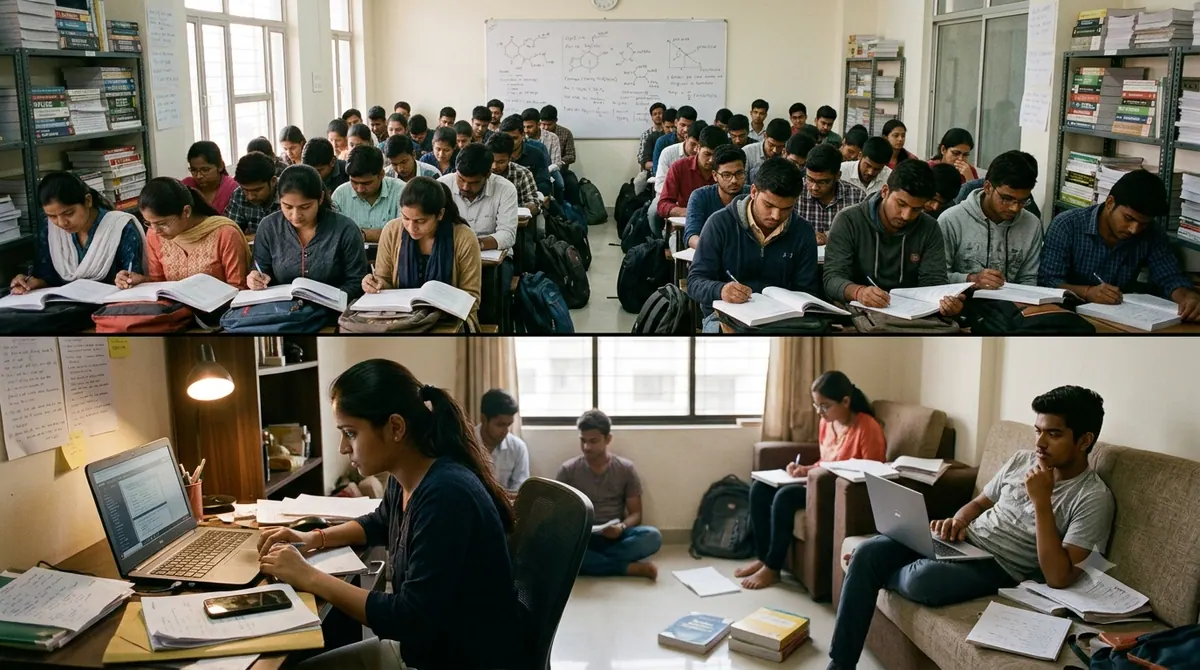
For millions of Indian students, school or college isn't the only place where education happens. Coaching centres, online teachers, test series and exam courses have created a massive parallel system. So has coaching quietly become India's second education system?
- Primary topic
- coaching industry India
- Category
- Education & Society
- Reading time
- 8 minutes
- Last reviewed
- 2026-09-09
School. College. And Then... Coaching.
For millions of Indian students, formal education follows a familiar path.
School.
College.
Degree.
But alongside that system, another one has grown enormously.
Coaching classes.
Online batches.
YouTube teachers.
Test series.
Mock exams.
Paid courses.
Telegram groups.
Recorded lectures.
Crash courses.
Doubt sessions.
For some students, coaching is optional.
For others, it feels almost mandatory.
That raises a genuinely uncomfortable question:
Has India quietly created a second education system?
Not one controlled through the same structure as schools and universities.
But one built around a single goal:
Help students win competitive examinations.
Formal Education and Exam Preparation Often Do Different Things
This is where the divide begins.
Schools and colleges are supposed to provide broad education.
They teach subjects, concepts and qualifications.
Competitive coaching is far more targeted.
It asks:
- What exactly is in the syllabus?
- What type of questions are repeated?
- How much time should each question take?
- Which topics carry the most weight?
- What mistakes eliminate candidates?
The two systems can overlap.
But their goals are different.
Formal education often asks:
“What should you learn?”
Coaching often asks:
“What do you need to do to clear this exam?”
That difference is huge.
Competitive Exams Created the Perfect Market for Coaching
India has large numbers of students competing for limited seats and vacancies.
Whenever selection depends heavily on a high-stakes examination, demand for specialised preparation naturally appears.
Think about:
- JEE
- NEET
- UPSC
- SSC
- Banking exams
- Railway recruitment
- State PSC examinations
- Police recruitment
- Teaching eligibility exams
Each exam has its own syllabus, patterns and strategies.
And wherever students believe specialised knowledge can improve their chances, a coaching market develops.
Academic research has described India's coaching ecosystem as a major social and educational space shaped by youth aspirations and competition for jobs.
So coaching didn't become huge by accident.
The structure of competitive selection created demand for it.
Coaching Does Something Formal Education Often Doesn't
Let's be fair.
Coaching survives because it provides something students clearly want.
Exam-specific guidance.
A coaching teacher may tell you:
- Don't study this chapter for three weeks.
- Focus on these concepts first.
- Here are the most common mistakes.
- Solve questions under time pressure.
- Your current score is not enough.
- This topic is your weakness.
That's extremely different from traditional classroom teaching.
Coaching is often designed around performance measurement.
How many questions can you solve?
How quickly?
How accurately?
Can you survive the actual exam?
For a student facing one high-stakes examination, this targeted approach can feel much more useful than broad academic teaching.
But Here Comes the Problem
If students need separate coaching to perform well in major examinations, people naturally start asking:
What exactly is the formal education system failing to provide?
The answer is not always simple.
Some exams test knowledge outside a student's academic course.
Some require enormous amounts of practice because competition is intense.
And some coaching simply provides structure that students struggle to create alone.
So coaching does not automatically prove that schools or colleges are “bad.”
But the dependence is still worth examining.
If formal education and competitive preparation become completely separate worlds, students can end up effectively studying twice.
Once to pass college.
Once to pass the exam that determines their next opportunity.
That is a lot of education.
The Coaching Ecosystem Is Now Bigger Than Physical Classrooms
This is where things have changed dramatically.
Earlier, students often had to move to famous coaching hubs.
Today, preparation can happen through:
- Live online classes
- Recorded lectures
- Mobile apps
- YouTube
- Online test series
- Digital notes
- AI-powered study tools
A student in a small town can now access teachers and preparation material that previously required relocation.
That is a massive change.
Recent reporting in 2026 has highlighted a growing push toward free online coaching for competitive-exam aspirants, partly driven by concerns about the financial burden private coaching can place on poor and middle-class families.
The rise of online learning could potentially make high-quality preparation more accessible.
But accessibility and equality are not exactly the same thing.
Coaching Can Reduce One Gap While Creating Another
A good teacher can help a student understand something they would otherwise struggle with.
Online resources can reduce geographical barriers.
Free content can help students who cannot afford expensive classes.
That's the positive side.
But expensive coaching can also create advantages.
One student may have:
- Full-time classroom coaching
- Personal mentorship
- Premium test series
- Better study material
- A dedicated study environment
Another may be:
- Working while preparing
- Studying from free videos
- Sharing a room with family
- Using an old phone
- Unable to afford multiple test series
Both technically have “access” to preparation.
Their preparation conditions are not remotely equal.
This is one reason the coaching industry creates serious debates around educational inequality.
Research from Stanford examining India's government-recruitment coaching ecosystem specifically explores how coaching can shape youth aspirations and potentially reproduce or mitigate inequality.
Has Coaching Created Dependence?
Sometimes.
Students can become convinced that they cannot prepare without a particular teacher, institute or course.
That's dangerous.
A good teacher should improve your ability to learn.
Not create permanent dependency.
If you finish six months of coaching but cannot independently analyse a question, revise a topic or identify your mistakes, something went wrong.
Coaching should ideally be a tool.
Not a substitute for thinking.
The “Best Teacher” Obsession Can Also Get Weird
Indian exam preparation has created something close to celebrity culture around teachers.
And honestly, it makes sense.
Students spend hundreds or thousands of hours learning from these people.
A good teacher can genuinely change how someone understands a subject.
But there is a problem when students start believing:
“If I don't study from this one specific person, I cannot clear the exam.”
No.
The teacher matters.
The material matters.
The strategy matters.
But eventually you have to sit in the exam hall.
There is no coaching centre that can solve the paper for you.
Not yet, anyway.
Is Coaching Filling a Gap or Creating One?
Probably both.
It fills a gap when formal education does not provide:
- Exam awareness
- Structured practice
- Individual feedback
- Career guidance
- Current and specialised preparation
But coaching can also create unhealthy pressure.
More students joining coaching can make other students feel they must join too.
Then preparation becomes an arms race.
“Everyone else has coaching, so I need coaching.”
That belief itself expands the market.
Eventually, coaching can start feeling like a compulsory stage between education and opportunity.
That's when the “second education system” argument becomes strongest.
Free Resources Are Changing the Game
One of the biggest disruptions is that quality learning material is no longer locked entirely inside expensive classrooms.
Students now have access to:
- Free lectures
- Previous-year questions
- Official notifications
- Online communities
- Free mock tests
- Educational websites
- Digital libraries
This doesn't mean every free resource is good.
The internet is also full of absolute garbage.
But a motivated student today can access far more learning material than previous generations.
The challenge is increasingly:
How do you know what to study?
Not just:
Where do you find something to study?
That's why curation matters.
Too many resources can become another problem.
You don't need 47 teachers for one subject.
You need a plan.
What Should the Future Look Like?
Probably not a world where coaching disappears.
Competitive exams will continue creating demand for specialised preparation.
The more useful goal may be to reduce unnecessary dependence.
Imagine if formal education better developed:
- Reasoning
- Problem-solving
- Communication
- Digital literacy
- Independent learning
Then specialised coaching could focus more narrowly on the unique requirements of a particular exam.
Instead of becoming a second full-time education system.
That would be healthier.
NITI Aayog's 2026 work on education and employment similarly argues for greater attention to learning outcomes rather than relying only on credentials.
The goal should be to make education more useful—not simply add more layers on top of it.
So, Has Coaching Become India's Second Education System?
Honestly?
In many parts of the country, it already functions like one.
Students finish school and attend coaching.
Students attend college and prepare separately for entrance or recruitment exams.
Students graduate and spend additional years inside the competitive-exam ecosystem.
That's more than a small side industry.
It's a parallel structure built around the reality of high-stakes competition.
The real question is not whether coaching should exist.
It obviously will.
The better question is:
Why do so many students feel they need an entirely separate education to compete after finishing their first one?
That's the question worth taking seriously.
Continue your preparation
Topics covered
About the author
Search Sarkari Naukri Team reviews government-job information, competitive-exam guidance and public-system explainers. Verify time-sensitive requirements on the relevant official authority's website.
Related articles
- Age Limit for Government Jobs 2026: Rules, Relaxation & How to Check — Government Job Guides
- Can Government Employees Start a YouTube Channel or Business? Rules Explained — Government Policies & Explained
- 10th and 12th Pass Government Jobs in India 2026: Best Career Options, Salary & How to Apply — Career Guide
- Bank Apprentice Jobs 2026: Graduate Apprentice Apply Guide — Government Job Guides
- Government Jobs Without Graduation 2026 – 10th & 12th Pass Jobs — Government Job Guides
- Group A, B, C & D Government Jobs Explained: Which One Is Right for You? — Career Guide