Why Do Indian Degrees Take So Long to Become Useful?
By: Search Sarkari Naukri Team · Published: · Updated: · 5 min read
Quick summary
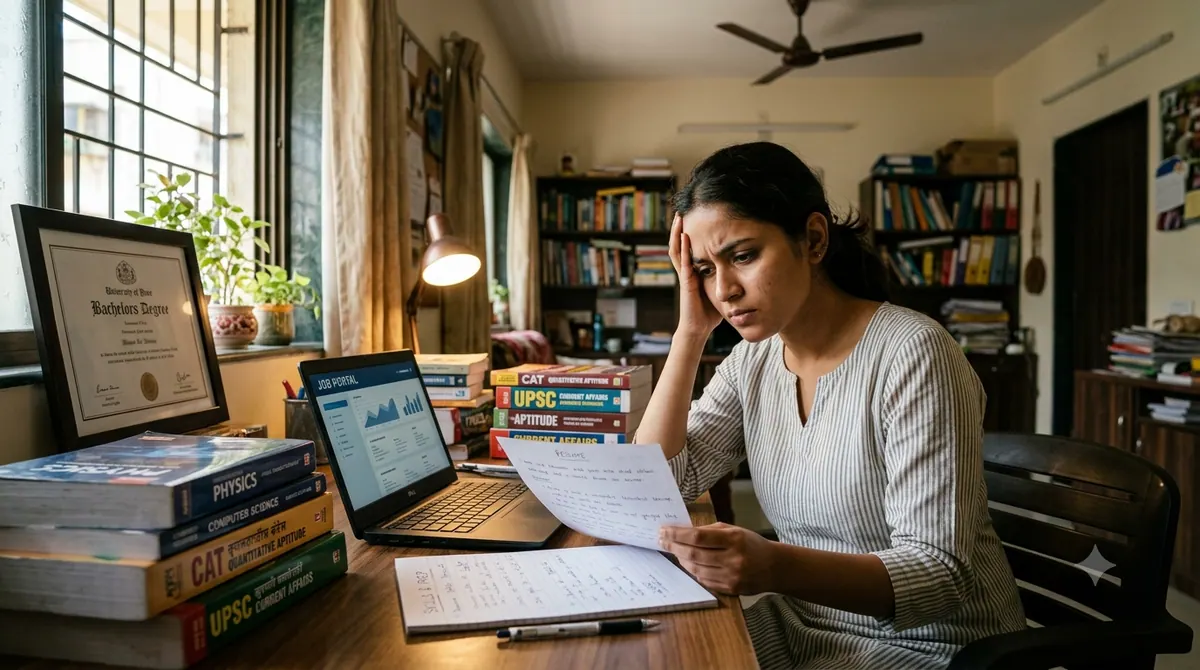
A degree can take three or four years to earn, yet many graduates still spend months preparing for exams, learning new skills or searching for work. Why does getting qualified and becoming job-ready often feel like two completely separate journeys?
- Primary topic
- Indian education
- Category
- Education & Society
- Reading time
- 5 minutes
- Last reviewed
- 2026-09-28
You Finished College. So Why Are You Still Preparing?
For many Indian students, graduation is supposed to be the finish line.
You spend three or four years attending lectures, writing assignments, appearing for practicals and somehow surviving semester exams.
Then you get the degree.
And suddenly, the next question arrives:
“Okay, but what job are you going to get?”
That's where things get weird.
A graduate may have a degree but still need to:
- Prepare for competitive exams
- Learn Excel or other digital tools
- Take certification courses
- Build a portfolio
- Improve communication skills
- Prepare for aptitude tests
- Learn interview skills
- Gain practical experience
So the obvious question is:
If a degree takes years to complete, why isn't graduation automatically enough to make someone job-ready?
The uncomfortable answer is that education, qualification and employability are not the same thing.
A Degree Proves Something. Just Not Everything.
A degree matters.
Let's not do the annoying internet thing where people suddenly pretend college is useless.
A degree can demonstrate that you completed a structured programme of study. It can provide subject knowledge and is often an eligibility requirement for jobs, further education and competitive examinations.
But a degree doesn't automatically prove that someone can perform every task required in a modern workplace.
That's because workplaces don't simply ask:
“What did you study?”
They also ask:
Can you solve unfamiliar problems? Can you communicate clearly? Can you learn new tools? Can you work with other people? Can you apply knowledge in practice? Can you adapt when technology changes?
That gap is where the problem begins.
India's Employability Numbers Show the Gap
Mercer's India's Graduate Skill Index 2025, based on data from more than 2,700 campuses and assessments of over one million students, reported that 42.6% of Indian graduates who apply for jobs were overall employable. The report also highlighted the growing importance of skills such as critical thinking, communication and learning agility.
That doesn't mean the remaining graduates are unintelligent.
Far from it.
It means academic qualification and immediate workplace readiness can be very different things.
Someone may understand a subject well but have little experience applying that knowledge outside an examination.
College and Employment Often Ask Different Questions
This is probably the core issue.
Education often focuses on whether a student has learned a defined body of knowledge.
Employment focuses more directly on whether someone can create value in a specific role.
Those two things overlap.
But they aren't identical.
A student may score highly in a theory examination and still struggle when asked to solve an unstructured real-world problem.
Another student may have average academic marks but be excellent at communication, problem-solving and learning new systems.
Traditional marksheets don't always capture that difference.
This Is Why Graduates Keep Studying After Graduation
You've probably seen this cycle:
Degree → Exam preparation → Skill course → Internship → Job preparation.
It can feel ridiculous.
“Why wasn't all of this part of the degree?”
Fair question.
Some institutions and programmes are improving practical learning and industry connections, but the transition from education to employment remains complicated.
A 2026 NITI Aayog working paper specifically examines India's education and skilling system through the lens of employment and argues for greater attention to learning outcomes rather than credentials alone.
That's the important distinction.
A credential says you completed something.
A learning outcome asks what you can actually do.
Government Exams Make the Difference Even More Obvious
For SSN's audience, this is especially relevant.
A graduate degree can make you eligible for many government examinations.
But eligibility is not selection.
A person can complete a B.A., B.Sc., B.Com. or B.Tech. and then spend months or years preparing separately for:
- SSC examinations
- Banking exams
- Railway recruitment
- State PSC examinations
- UPSC
- Other graduate-level recruitment
Why?
Because the selection process tests a specific set of abilities under a competitive system.
The degree and the recruitment exam have different purposes.
One provides an educational qualification.
The other ranks candidates for a limited number of jobs.
That is why “I have a degree” and “I am ready for this exam” are two separate statements.
SSN itself reflects this distinction by providing tools such as its eligibility checker alongside exam and study resources—being eligible for an exam is only the first step, not proof of readiness or selection.
Are Students Over-Credentialed and Under-Skilled?
Sometimes.
But this phrase gets abused.
Having more qualifications isn't automatically bad.
The problem appears when people collect certificates without developing corresponding abilities.
Imagine someone with:
- A degree
- Five online certificates
- Three workshop certificates
But they cannot clearly demonstrate what they can actually do.
That's credential accumulation.
It looks impressive until somebody asks:
“Show me.”
The future may increasingly reward evidence of ability alongside qualifications.
Can you solve the problem?
Can you explain your reasoning?
Can you learn the tool?
Can you adapt?
Those questions are harder to answer with a certificate alone.
Technology Is Making the Gap More Visible
Earlier, a skill could remain useful for years without changing dramatically.
Now, technology moves faster.
Software changes.
AI tools appear.
Workflows get automated.
Entirely new roles emerge.
Mercer's 2025 findings showed a particularly interesting pattern: employers are placing increasing value on soft skills such as critical thinking, communication and learning agility, while the skills needed to work alongside AI are also becoming more relevant.
This means education cannot simply be about memorising today's information.
Tomorrow's information and tools may be different.
The ability to keep learning becomes a skill itself.
So What Actually Makes a Degree Useful?
Not the certificate alone.
A degree becomes much more valuable when combined with things such as:
1. Subject Understanding
Actually knowing what you studied still matters. Crazy concept, apparently.
2. Practical Application
Can you use that knowledge to solve something?
3. Communication
Can you explain your ideas to another human without making everyone regret asking?
4. Digital Skills
Modern work increasingly requires comfort with digital systems.
5. Learning Agility
Can you learn something new when the old method becomes outdated?
6. Evidence of Ability
Projects, internships, practical work and demonstrable skills can show what a person is capable of beyond an exam score.
The Degree Isn't Broken. But the Old Promise Might Be.
For decades, the implied formula was simple:
Study hard → Get degree → Get job.
Reality is now more complicated.
For many people, the formula looks more like:
Study → Get degree → Keep learning → Prove skills → Compete → Adapt.
That's exhausting.
But pretending the old formula still guarantees employment doesn't help students either.
The smarter approach is to understand the difference early.
Frequently asked questions
You Finished College. So Why Are You Still Preparing?
For many Indian students, graduation is supposed to be the finish line. You spend three or four years attending lectures, writing assignments, appearing for practicals and somehow surviving semester exams. Then you get the degree. And suddenly, the next question arrives: “Okay, but what job are you going to get?” That's where things get weird. A graduate may have a degree but still need to: Prepare for competitive ex
If a degree takes years to complete, why isn't graduation automatically enough to make someone job-ready?
The uncomfortable answer is that education, qualification and employability are not the same thing. A Degree Proves Something. Just Not Everything. A degree matters. Let's not do the annoying internet thing where people suddenly pretend college is useless. A degree can demonstrate that you completed a structured programme of study. It can provide subject knowledge and is often an eligibility requirement for jobs, fur
Why?
Because the selection process tests a specific set of abilities under a competitive system. The degree and the recruitment exam have different purposes. One provides an educational qualification. The other ranks candidates for a limited number of jobs. That is why “I have a degree” and “I am ready for this exam” are two separate statements. SSN itself reflects this distinction by providing tools such as its eligibili
Are Students Over-Credentialed and Under-Skilled?
Sometimes. But this phrase gets abused. Having more qualifications isn't automatically bad. The problem appears when people collect certificates without developing corresponding abilities. Imagine someone with: A degreeFive online certificatesThree workshop certificates But they cannot clearly demonstrate what they can actually do. That's credential accumulation. It looks impressive until somebody asks: “Show me.” Th
Can you adapt?
Those questions are harder to answer with a certificate alone.
So What Actually Makes a Degree Useful?
Not the certificate alone. A degree becomes much more valuable when combined with things such as: 1. Subject Understanding Actually knowing what you studied still matters. Crazy concept, apparently. 2. Practical Application
Can you use that knowledge to solve something?
3. Communication
Can you explain your ideas to another human without making everyone regret asking?
4. Digital Skills Modern work increasingly requires comfort with digital systems. 5. Learning Agility
Can you learn something new when the old method becomes outdated?
6. Evidence of Ability Projects, internships, practical work and demonstrable skills can show what a person is capable of beyond an exam score. The Degree Isn't Broken. But the Old Promise Might Be. For decades, the implied formula was simple: Study hard → Get degree → Get job. Reality is now more complicated. For many people, the formula looks more like: Study → Get degree → Keep learning → Prove skills → Compete →
Continue your preparation
Topics covered
About the author
Search Sarkari Naukri Team reviews government-job information, competitive-exam guidance and public-system explainers. Verify time-sensitive requirements on the relevant official authority's website.
Related articles
- Age Limit for Government Jobs 2026: Rules, Relaxation & How to Check — Government Job Guides
- Can Government Employees Start a YouTube Channel or Business? Rules Explained — Government Policies & Explained
- 10th and 12th Pass Government Jobs in India 2026: Best Career Options, Salary & How to Apply — Career Guide
- Bank Apprentice Jobs 2026: Graduate Apprentice Apply Guide — Government Job Guides
- Government Jobs Without Graduation 2026 – 10th & 12th Pass Jobs — Government Job Guides
- Group A, B, C & D Government Jobs Explained: Which One Is Right for You? — Career Guide