Why Are QR Codes Everywhere in India Now?
By: Search Sarkari Naukri Team · Published: · Updated: · 6 min read
Quick summary
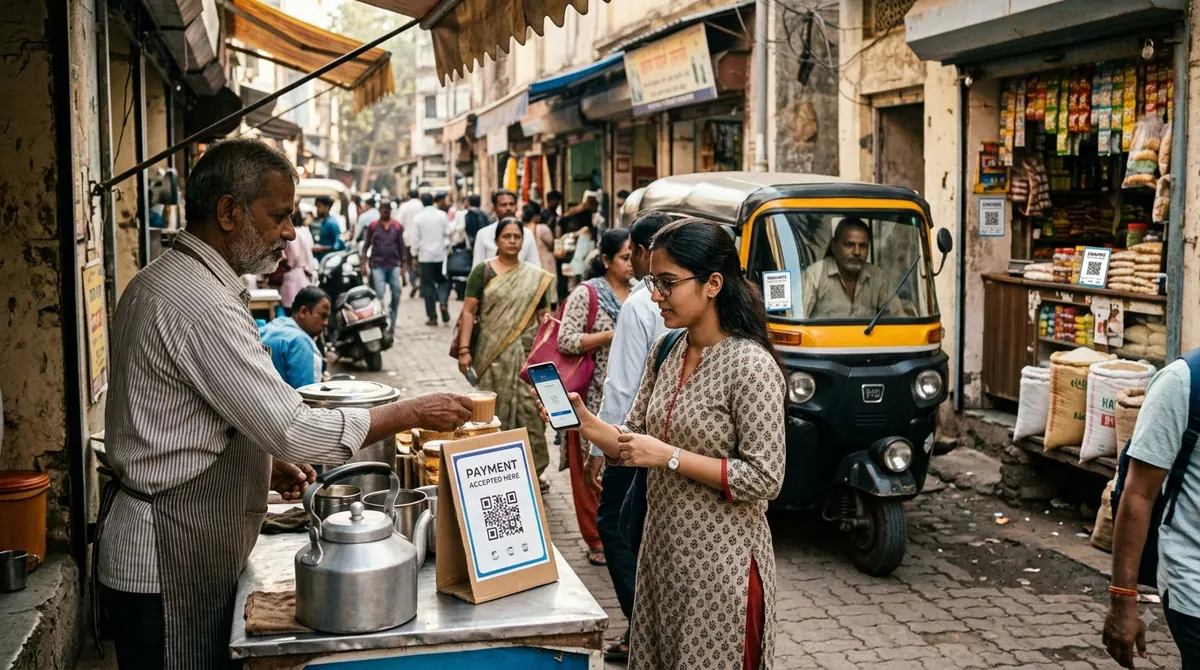
From chai stalls and auto-rickshaws to shopping malls and temples, QR codes are everywhere in India. But how did a technology invented decades ago become one of the biggest symbols of everyday Indian life?
- Primary topic
- QR codes in India
- Category
- Technology & India
- Reading time
- 6 minutes
- Last reviewed
- 2026-10-02
Look Around. There's Probably a QR Code Near You.
At a chai stall.
Inside an auto-rickshaw.
At the local kirana shop.
Outside a temple donation box.
At a restaurant.
Even at places where the total bill is ₹10.
Just scan.
Enter the amount.
Pay.
Done.
The QR code has become so normal in India that we barely notice it anymore.
But if you think about it for a second, the transformation is kind of wild.
A small black-and-white square has become one of the most recognisable pieces of technology in everyday India.
So how did this happen?
First, QR Codes Were Not Invented for UPI
QR stands for Quick Response.
The technology was invented in Japan in the 1990s and was originally developed for tracking components in the automobile industry.
The basic idea was simple: a QR code could store more information than a traditional barcode and could be scanned quickly.
Nobody back then was designing it for a roadside chai seller in India.
Yet somehow, decades later, that's exactly where it ended up.
India Had the Perfect Conditions for QR Payments
The QR code itself wasn't the magic.
India's digital ecosystem made it useful.
A major turning point came with the growth of smartphones, mobile internet and instant digital payments.
NPCI launched the Unified Payments Interface, or UPI, in 2016. UPI allows instant bank-to-bank payments between parties and was built over India's existing IMPS infrastructure.
Once people could transfer money instantly from their phones, the next question became obvious:
How do you make paying a shopkeeper ridiculously easy?
Enter the QR code.
A QR Code Is Basically a Digital Shortcut
Without a QR code, imagine manually entering:
- A bank account number
- An IFSC code
- A mobile number
- Or another payment identifier
Every single time you wanted to pay someone.
Yeah, nobody wants to do that for a ₹20 chai.
A QR code makes the process much simpler.
The merchant displays a code.
You scan it through a compatible payment app.
The payment details are pulled into the transaction flow.
You authorise the payment.
That's it.
The Biggest Reason QR Codes Won: They're Cheap
This might be the real genius behind their explosion.
Traditional card payments can require infrastructure such as card machines or point-of-sale terminals.
A QR code can literally be printed on paper.
That dramatically reduces the barrier for small merchants.
A tiny roadside seller doesn't need to invest in a complicated payment machine just to accept digital payments.
They can display a QR code.
Suddenly, a small shop and a major retail store can both accept digital payments.
The scale of this system is massive. NPCI's milestones show that common QR standards were already being developed for interoperable payments in 2017, allowing merchants to display QR codes that could work across supported payment methods and applications.
Then India Stopped Carrying Cash Everywhere
Not completely, obviously.
Cash is still very much alive.
But the behaviour changed.
Earlier, one of the most annoying situations was:
“Do you have change?”
Now it is often:
“QR hai?”
That tiny change in language says a lot.
People became comfortable paying small amounts digitally.
₹50.
₹100.
₹247.
₹1,000.
The amount didn't necessarily matter.
If the shop had a QR code, you could pay.
UPI Made the QR Code Even More Powerful
The QR code by itself doesn't move money.
The payment infrastructure behind it does.
UPI became the engine that made instant mobile payments feel normal.
According to NPCI, UPI allows instant transfers between bank accounts, while official 2026 government data described UPI as the world's largest real-time retail payment system. It accounted for 81% of India's retail digital payments in FY 2024-25.
By May 2026, NPCI's statistics showed more than 23.2 billion UPI transactions in a single month, involving 720 banks live on the system.
At that scale, QR codes aren't some cool tech feature anymore.
They're infrastructure.
Why Did Indians Adopt It So Quickly?
There wasn't just one reason.
It was a perfect combination of factors:
1. Cheap Smartphones
Smartphones became accessible to far more people than they were a decade earlier.
A payment system that lives inside your phone becomes more useful as smartphone ownership expands.
2. Cheap Mobile Internet
This is where our second blog comes in.
Mobile data became dramatically more affordable over the years, helping make internet-based services part of daily life.
A QR payment system is much easier to use when getting online doesn't feel expensive.
3. No Need for Expensive Hardware
This was huge for small businesses.
Print the code.
Display it.
Start accepting payments.
Simple.
4. Instant Payments
Nobody wants to wait three days for a chai payment to clear.
UPI made instant transfers normal.
5. Network Effect
This is the part that accelerated everything.
More customers started using QR payments.
So more shops displayed QR codes.
Then because more shops accepted them, more customers started relying on them.
The system kept feeding itself.
QR Codes Escaped the World of Shopping
At first, digital payment QR codes were mostly associated with shops and businesses.
Now they're everywhere.
You can see them used for:
- Shop payments
- Restaurant bills
- Auto-rickshaw fares
- Donations
- Street vendors
- Delivery payments
- Parking
- Small service businesses
The QR code became an interface between the physical world and your bank account.
That's a pretty insane achievement for a square pattern that most people don't even think about anymore.
India Basically Changed the Meaning of “I Don't Have Cash”
A few years ago, if someone didn't have cash, a small transaction could become annoying.
Today?
The phone comes out.
The code gets scanned.
Done.
This has also changed how small merchants think about payments.
Earlier, accepting digital payments could feel like something mainly for larger businesses.
QR payments helped bring that capability to businesses of almost any size.
But QR Payments Aren't Perfect
Obviously.
The growth of QR payments has also created new risks.
Scammers know that people have become extremely comfortable scanning codes.
That's why users need to understand something important:
Receiving money and sending money are not the same thing.
You should never enter your UPI PIN just because someone claims they are sending you money.
Your UPI PIN authorises a debit from your account.
NPCI specifically advises users not to share their UPI PIN with anyone.
So yes, QR payments are convenient.
But blind trust is dumb.
The Most Interesting Part
India didn't invent the QR code.
India didn't invent smartphones.
India didn't invent digital payments.
But India combined these technologies in a way that made QR-based payments part of ordinary daily behaviour.
That's the real story.
A technology created for industrial tracking became a payment tool used by everyone from major retailers to roadside vendors.
Final Take
QR codes are everywhere in India because they solved a very simple problem:
How do you make digital payments easy enough for almost anyone to use?
No expensive card machine.
No long bank details.
No hunting for exact change.
Just:
Scan. Pay. Done.
And once millions of people got used to that, there was no going back.
Frequently asked questions
How do you make paying a shopkeeper ridiculously easy?
Enter the QR code.
Why Did Indians Adopt It So Quickly?
There wasn't just one reason. It was a perfect combination of factors: 1. Cheap Smartphones Smartphones became accessible to far more people than they were a decade earlier. A payment system that lives inside your phone becomes more useful as smartphone ownership expands. 2. Cheap Mobile Internet This is where our second blog comes in. Mobile data became dramatically more affordable over the years, helping make inter
Today?
The phone comes out. The code gets scanned. Done. This has also changed how small merchants think about payments. Earlier, accepting digital payments could feel like something mainly for larger businesses. QR payments helped bring that capability to businesses of almost any size.
How do you make digital payments easy enough for almost anyone to use?
No expensive card machine. No long bank details. No hunting for exact change. Just: Scan. Pay. Done. And once millions of people got used to that, there was no going back.
Continue your preparation
Topics covered
About the author
Search Sarkari Naukri Team reviews government-job information, competitive-exam guidance and public-system explainers. Verify time-sensitive requirements on the relevant official authority's website.
Related articles
- Why Is Mobile Internet So Cheap in India? The Real Story — Technology & India
- Age Limit for Government Jobs 2026: Rules, Relaxation & How to Check — Government Job Guides
- Can Government Employees Start a YouTube Channel or Business? Rules Explained — Government Policies & Explained
- 10th and 12th Pass Government Jobs in India 2026: Best Career Options, Salary & How to Apply — Career Guide
- Bank Apprentice Jobs 2026: Graduate Apprentice Apply Guide — Government Job Guides
- Government Jobs Without Graduation 2026 – 10th & 12th Pass Jobs — Government Job Guides